‘Lucky Strike’ Measures Honor by Words and Deeds
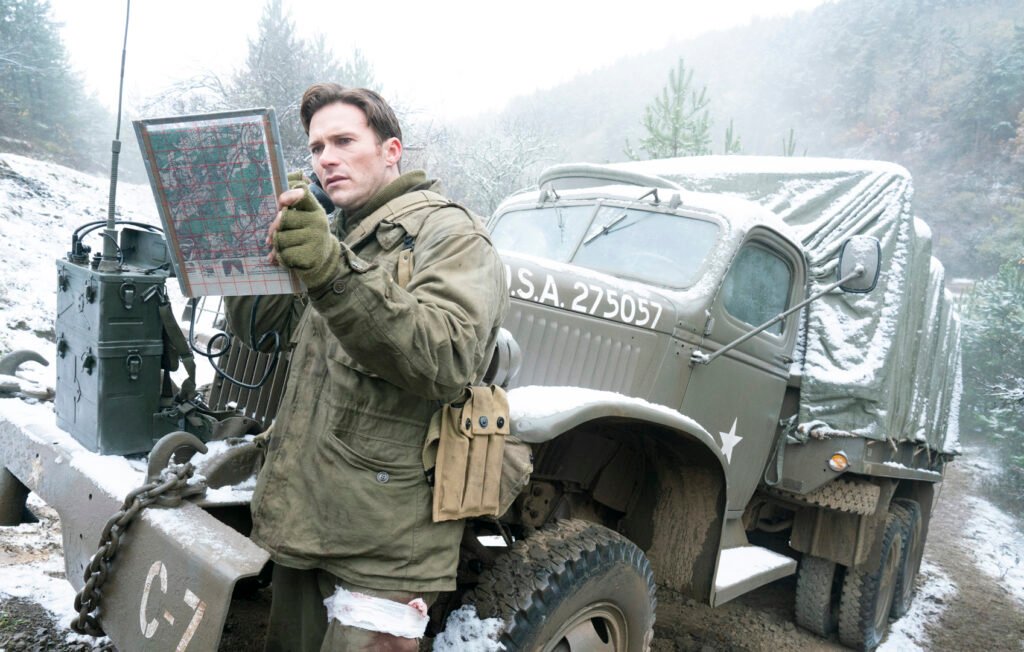
The freezing woods of Belgium are not the only danger in Lucky Strike. The greater danger is the world that made those woods a battlefield: a world where pride, ambition, and racial contempt had been organized into power.
Into that world comes John Castle, an American soldier cut off behind German lines during the Battle of the Bulge. Wounded, isolated, and dependent on a Motorola SCR-300 radio, Castle must move through enemy territory as Nazi Germany launches its last major offensive in Western Europe. His situation gives the film immediate tension, but his journey gives it meaning.
Castle is not presented as a man discovering decency under pressure. He already carries it. The film’s interest is in watching that decency become visible through words and deeds, especially when dishonorable people around him reveal themselves by contempt, cruelty, and the use of power without conscience.
Directed by Rod Davis Lurie, Lucky Strike stars Scott Eastwood as Castle, a soldier whose path through the snow becomes more than a fight for survival. Eastwood gives him a restrained physical presence suited to the role, allowing Castle’s character to emerge through movement, judgment, and endurance rather than speeches. The wartime structure is familiar: one man, limited resources, hostile ground, and the constant possibility of discovery. Yet the film works best when it looks beyond escape and asks what honor looks like when the surrounding world has become dishonorable.
That distinction is made clear through conduct. Castle’s journey represents the honorable, but the film does not leave honor with him alone. Without revealing one of the movie’s most meaningful turns, Lucky Strike shows that honor is not assigned by uniform, rank, race, or nationality. It is revealed in how people speak, what they protect, what they risk, and whether they recognize the dignity of others when doing so comes at a cost.
That idea gives the film a stronger moral shape than a simple behind-enemy-lines thriller. Castle is not admirable because he is fearless. He is admirable because he rises to the occasion without becoming careless with human life. He must be cautious, disciplined, and willing to act, but the film does not confuse courage with hardness. It allows courage to include restraint.
The enemy he faces is not merely another army. Nazi Germany’s war was driven by unrestrained ambition and uncompromising pride, joined to a racial ideology that sorted human beings by blood, ancestry, usefulness, and supposed worth. Its dishonor was visible not only in what it did, but in what it said about people before it acted against them. Words prepared the way for deeds.
That is part of what makes Lucky Strike worth considering for readers of the American Israelite. The film’s setting belongs to World War II, but its moral warning reaches further back. War begins before armies move. It begins when contempt becomes acceptable, when ambition is no longer restrained by conscience, and when people are taught to see others as categories instead of neighbors.
For American viewers, that warning should not invite easy self-congratulation. The United States fought Nazi Germany, and that fight was necessary. Yet racial distinctions also marked American life, thought, and law. Segregation, exclusion, and eugenic ideas were not foreign to this country. Nazi Germany carried racial pride and antisemitic hatred to catastrophic and murderous ends, but the habit of measuring human worth by false categories had roots across much of the modern world.
Against that background, Castle’s ordinary decency matters. He is one man, like many others, placed in a terrible hour and asked to rise. History often remembers battles through dates, maps, commanders, and casualties. Lucky Strike narrows the view to people whose words and deeds reveal who they are when pressure comes.
The film has familiar elements, and some of its survival-story structure follows expected paths. But its best moments are not weakened by familiarity because the underlying distinction remains clear. Honorable people protect life, keep faith, and rise when the moment demands it. Dishonorable people diminish life, use power without conscience, and reveal contempt through both language and action.
Lucky Strike is a war film, but its better achievement is its human scale. One soldier, one radio, one dangerous road, and one moral line held against a world that had crossed too many. Castle’s journey represents the honorable, but the film’s deeper strength is that he is not alone. In a world made brutal by pride and racial contempt, Lucky Strike honors those whose words and deeds still recognize the worth of another human being.
