Shattering the Closets: An Interview with Ilan Goldman
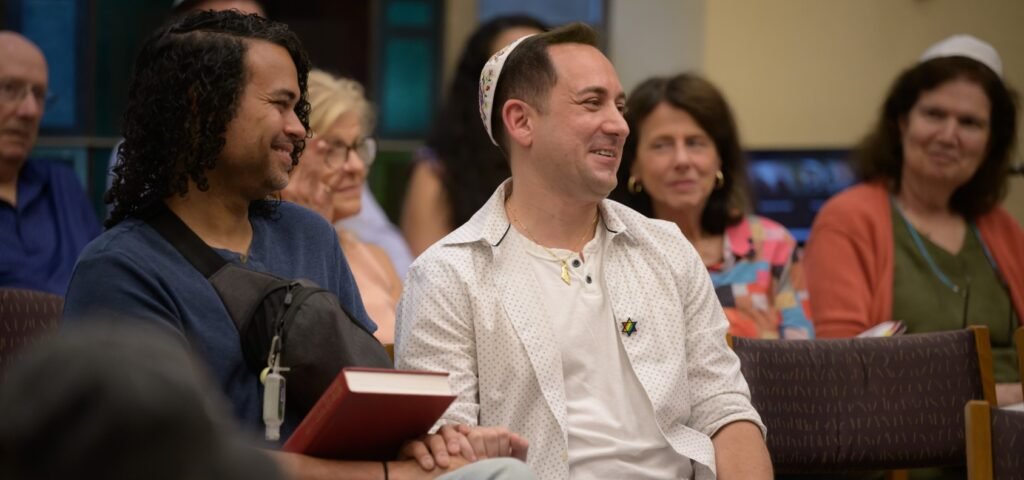
This article is based on a personal interview with Ilan Goldman. The views and experiences expressed are those of the author and interview subject in their personal capacities and do not represent the views of any employer or organization with which either is affiliated.
June is Pride Month, and while the month is dedicated to celebrating the LGBTQ+ community, a recent conversation with my longtime friend Ilan Goldman left me thinking about something broader.
Ilan is gay, Jewish, Israeli, a Zionist, and a former IDF tank commander. His upcoming presentation is called Shattering the Closets, and at first glance, you might assume it is simply a story about coming out as a gay man. It is. But it is also much more than that.
As Ilan and I talked, I realized the lesson of Shattering the Closets is not that everyone’s struggles are the same. They aren’t. I cannot fully understand what it was like for Ilan to come out as a gay man, nor should I pretend that the challenges faced by the LGBTQ+ community are identical to those faced by any other group.
What I can do is learn from his experience. As a friend, a fellow Jew, and someone who has spent plenty of time worrying about what other people think, I found myself asking a different question: What can the rest of us learn from someone who has spent a lifetime navigating the challenge of being authentically himself?
One thing that surprised me was that Ilan’s first experience coming out of the closet was not nearly as traumatic as many people might assume. Like many people, he initially feared rejection and worried about how his family would react, especially his mother. Instead, when he came out to her, he was met with love and acceptance. Much of the fear he had carried with him began to fade almost immediately.
The timing was remarkable. Later that same day, he found himself in Tel Aviv celebrating with the LGBTQ+ community after Dana International’s Eurovision victory. For the first time, he was publicly and openly part of a community that accepted him exactly as he was.
Not everyone is fortunate enough to have an experience like that. For many people, opening the closet door is met with rejection, anger, or isolation. Some lose friendships. Some lose family relationships. Some spend years rebuilding their confidence after taking that step. Perhaps that is part of what makes Ilan’s story so interesting. The first closet turned out to be far less frightening than he expected, and the acceptance he found gave him the confidence to live openly.
The irony is that years later, after successfully navigating that journey, he found himself confronting entirely different closets. Not because he was gay, but because he was Jewish, Israeli, and Zionist.
After moving to West Hollywood in 2002, one of the most LGBTQ-friendly communities in the world, he found himself confronting a challenge he never expected. He was comfortable being openly gay, but increasingly found himself wondering whether it was safe or wise to be openly Israeli. During the years of the Second Intifada, Ilan recalls encountering hostility toward Israel in places that otherwise championed tolerance and inclusion. He also recalls seeing signs that read “Stop Arming Israel,” “Stop Funding Israeli Apartheid,” and even “No Entrance to Israelis.” At one point his car was keyed with the words “Israeli, Go Home.”
Looking back, Ilan believes the attitudes he encountered long predated October 7. In his view, what has changed is not their existence but their visibility and acceptance. What has changed is not their existence, but their visibility and acceptance.
One of the more interesting parts of our discussion centered on the idea that, in some circles today, it can be easier to come out as gay than as a Zionist. Speaking from his own experience, Ilan told me that’s exactly what he’s found. When I asked how it makes him feel, he didn’t talk about fear. He talked about disappointment.
He is now in his early forties and thought we would be further along than this. Instead, he finds himself having many of the same conversations over and over again. Different people. Different settings. The same assumptions. He compared it to the movie *Groundhog Day*.
That reality has practical consequences. Ilan told me that when he travels internationally, he often finds himself thinking about where and when he displays visible symbols of his identity. Wearing an Israel necklace may seem like a small thing, but he regularly asks himself whether a particular environment is safe and whether it is wise to draw attention to himself. He told me that he is often most cautious in parts of Western Europe and in major American cities such as New York, Chicago, Los Angeles, and Washington, D.C.
His caution is not theoretical. Shortly after October 7, while visiting Washington with the American Jewish Committee, he came across a Pride event while wearing a necklace featuring a Star of David and a map of Israel. Expecting to find common ground, he instead found hostility. Ilan recalls what he describes as being confronted, spit on, shouted down, and nearly drawn into a physical altercation.
For him, the experience perfectly captured the tension at the heart of *Shattering the Closets*. The same space that celebrated one part of his identity rejected another.
Despite all of this, Ilan remains remarkably optimistic. When I asked what gives him hope, he did not point to politicians, organizations, or social movements. He pointed to people.
Since October 7, Ilan has lost friendships, but he has also gained a new appreciation for the power of curiosity. Some reactions were exactly what he expected. Others completely surprised him. What stood out most were the people who approached him wanting to learn, not just about Israel or Zionism, but about his experiences as a gay man as well. Many had little personal connection to either the Jewish or LGBTQ+ communities. They were not hostile. They were simply unfamiliar. That realization has changed the way he approaches people. Rather than assuming where someone stands, he has learned to leave room for curiosity, conversation, and the possibility that people may surprise you.
His advice is simple: be open, be caring, and be welcoming. Give people the opportunity to know who you are, and give yourself the opportunity to know them as well. You might be surprised who becomes a great friend.
Ilan also told me that Israel gives him hope. For all of its flaws and challenges, it remains one of the few places where he feels he can be openly Jewish, openly gay, openly Israeli, and openly Zionist at the same time. He does not have to separate those identities or decide which one is acceptable on a given day. He can simply be himself.
As our conversation came to a close, I asked Ilan to summarize the message of *Shattering the Closets*. His answer, paraphrased, was simple: life is short and life is fragile. Do not spend your best years hiding who you are or worrying about what everyone else thinks. Learn who you are. Accept who you are. Live authentically.
Perhaps that is what resonated with me most about my conversation with Ilan. Not because our journeys are the same. They aren’t, and I would never pretend otherwise. His experiences as a gay man, a Jew, an Israeli, and a Zionist are uniquely his own.
What I took away from our conversation was not a comparison of struggles, but a lesson in authenticity. There is courage in refusing to let other people decide who you are allowed to be. There is freedom in accepting yourself before seeking acceptance from others. And there is wisdom in approaching people with curiosity rather than assumptions, recognizing that the people who surprise you are often the ones who teach you the most.
For Ilan, that lesson has led him to become more open, more curious, and less likely to place people into neat ideological boxes. He has learned that support often comes from unexpected places and that many people are not hostile, merely unfamiliar. Sometimes all they need is the opportunity to learn.
That may be Ilan’s story, but I think there is something in it for all of us.
