The Storm Before Normandy
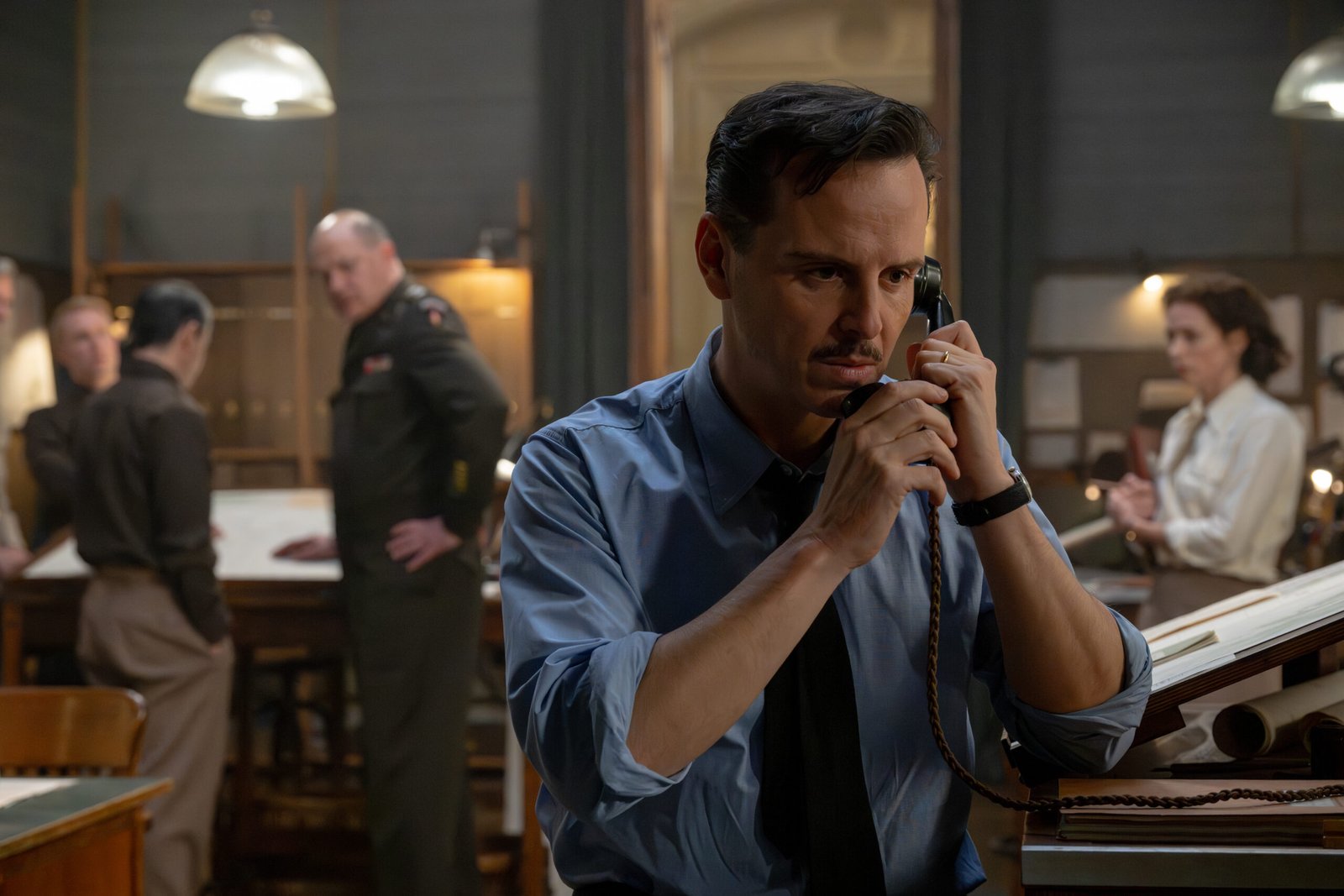
Anthony Maras’s wartime drama Pressure begins where many D-Day stories do not: before the boats, before the beaches, before the order that would send thousands of men toward the coast of Normandy. Starring Andrew Scott as meteorologist James Stagg, Brendan Fraser as Gen. Dwight D. Eisenhower, and Kerry Condon as Kay Summersby, the film narrows its attention to the tense 72 hours before the invasion, when the fate of the operation turned, in part, on a weather forecast.
That focus gives Pressure its best idea. The movie is not driven by battlefield spectacle, but by the dread of decision. Rain, wind, cloud cover, tide, moonlight, timing — details that might ordinarily belong to the background become matters of life and death. Launch too soon, and the invasion could become a catastrophe. Wait too long, and a rare opening might disappear.
Maras uses that narrow frame to build tension patiently. The drama comes from rooms full of exhausted people trying to read signs correctly: charts, reports, forecasts, faces. The film understands that suspense does not always require movement. Sometimes it comes from delay, disagreement, and the knowledge that every hour lost or gained may change the fate of thousands.
Andrew Scott’s Stagg stands at the center of that uncertainty. His forecast is serious, reasoned, and unwelcome. It cuts against the desire for momentum and forces military leaders to confront what they cannot command. Scott gives Stagg the bearing of a man who knows the difference between doubt and carelessness. He is not indecisive; he is responsible enough to resist false certainty.
Brendan Fraser’s Eisenhower carries the other side of the burden. He must hear the arguments, absorb the risk, and make the final call. Fraser’s performance is most effective when it is restrained, allowing the pressure of command to show in silence as much as speech. The drama rests in that exchange between knowledge and authority, evidence and action.
What makes the conflict compelling is that it is not a simple contest between courage and cowardice. The men in the room are not divided by purpose. They all understand the necessity of the invasion and the evil they are fighting. The tension comes from the harder problem of responsibility under uncertainty. In war, even a correct decision may carry a terrible cost.
The title is well chosen. Pressure is not treated merely as anxiety or strain. It is the force that bears down when reality refuses to simplify itself. Stagg cannot make the weather obey him. Eisenhower cannot make the consequences vanish. Each man is required to act within limits, and the film is strongest when it allows those limits to remain heavy.
As a reflection on D-Day, Pressure also invites gratitude without turning sacrifice into sentiment. The Allied forces were pushing back against a regime that had already brought devastation across Europe and death to millions. The men who landed in Normandy, and the men and women from many nations who supported the effort, deserve remembrance marked by clarity as well as reverence.
The defeat of Nazi Germany would lead to the liberation of concentration camp prisoners and alter the course of the world that followed. Pressure does not try to answer every question raised by war, evil, and suffering, nor should it. Its achievement is narrower and more disciplined. It places viewers inside one terrible historical pause, when weather, will, responsibility, and moral consequence gathered before the order was given.
