Ladies, Let’s Talk About Hair
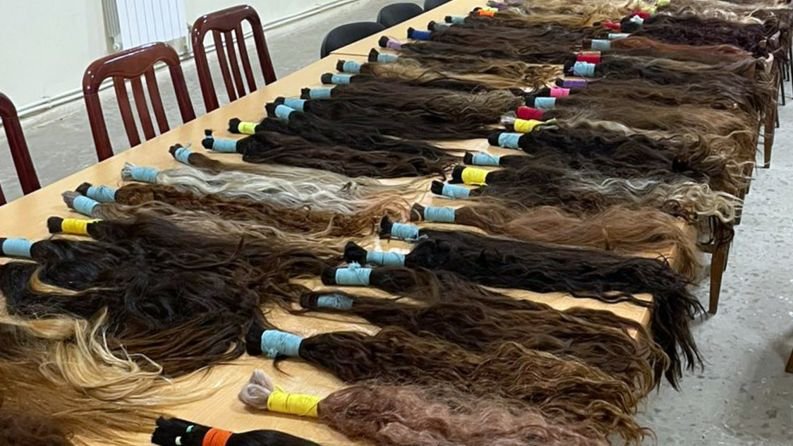
For many women, hair is deeply personal. When nature doesn’t cooperate, we color it, straighten it, curl it, extend it, and sometimes replace it entirely. For Orthodox Jewish women, the relationship can be even more complicated. Many married women cover their hair and invest thousands of dollars in beautiful human-hair sheitels.
Over the past several months, wig makers and hair professionals have reported a noticeable influx of inexpensive virgin human hair entering the market. One Los Angeles wig maker recently remarked that she had never seen so much hair available. For most consumers, that might sound like an industry footnote, but for the Persian diaspora, these reports are terrifying.
The global human-hair trade is notoriously opaque. Hair passes through brokers, exporters, wholesalers, and manufacturers before it ever reaches a wig shop. By the time a woman tries on a sheitel in Brooklyn, Jerusalem, or Cincinnati, tracing the hair’s true origin can be nearly impossible.
That is why recent reports from Armenia have attracted so much attention. Earlier this month, Armenian customs officials announced they had intercepted 143 bundles of human hair weighing 26 kilograms hidden inside pillows in a truck entering from Iran. More strikingly, officials revealed that this was merely the latest in a series of smuggling attempts. Since January, Armenian authorities say they have seized 621 bundles of human hair weighing more than 135 kilograms.
On one level, these seizures answered a mystery. Wig makers had been reporting an unusual influx of Iranian hair into the global market. Now we knew where some of it was coming from. But the seizures raised a far more troubling question: whose hair is it?
Jewish readers do not need to be taught why this matters. When Soviet forces liberated Auschwitz in 1945, they found masses of human hair shorn from prisoners and murder victims, packed for shipment to German factories in bags weighing roughly 20 to 22 kilograms. One truck stopped at the Armenian border was carrying 26 kilograms of human hair. Since January, Armenian authorities say they have seized more than 135 kilograms. Those numbers should stop every Jewish reader cold.
This is not about claiming Iran is Auschwitz. It is about remembering what Jewish history has already taught us: when a regime treats human beings as disposable, it will eventually find a way to profit from their bodies. Human hair is not just another raw material. It belonged to someone. And before any Jewish woman puts it on her head, before any sheitel maker sells it as a bargain, someone needs to answer the most basic question: whose hair is this?
While we cannot prove where every strand came from, the obvious defense will be that some Iranian women sold their hair out of economic desperation. That may be true. But it is not the comfort some people think it is. Women selling pieces of themselves to survive is not a clean supply chain; it is a national humiliation. And it still does not answer the most obvious question: if this was simply legally obtained hair from willing sellers, why was it hidden inside pillows and smuggled across a border?
The regime and its defenders will blame the war, sanctions, America, Israel — anyone but Tehran. But Iranian women were selling their hair out of poverty long before this latest crisis, and poverty is only half the story. The Islamic Republic created both conditions: the economic collapse that drives women to sell their hair, and the terror state that gives the world reason to fear what else may be in those shipments. Maybe some of this hair was sold by desperate women. Maybe some of it came from somewhere far darker. Either way, cheap human hair flooding the market from Iran, with no clear origin and no clean answers, is not a clearance sale. It is tainted goods.
No matter where one stands on the war, on Israel’s strikes, or on the politics of Iran, this should be morally simple. If human hair is entering the market from a regime that disappears women, imprisons protesters, and refuses to return bodies, then Jewish ethnics demand that we have a responsibility to ask questions before wearing it.
A sheitel is not just a fashion purchase. It is not synthetic fiber. It is human hair. It once belonged to a real woman with a name, a body, a family, and a story. If that hair was sold freely, ethically, and transparently, then sellers should be able to say so. If they cannot, then Jewish buyers should be cautious.
Ask your sheitel maker where the hair came from. Ask whether they can document the source. Ask whether any Iranian hair has entered their supply chain since January. Ask whether their wholesalers know more than they are saying. And if a human-hair wig suddenly seems too cheap to be true, maybe the question is not why it costs so little. Maybe the question is who paid the real price.
