The Mystery of the Missing Poppy Seed Filling: Part 1
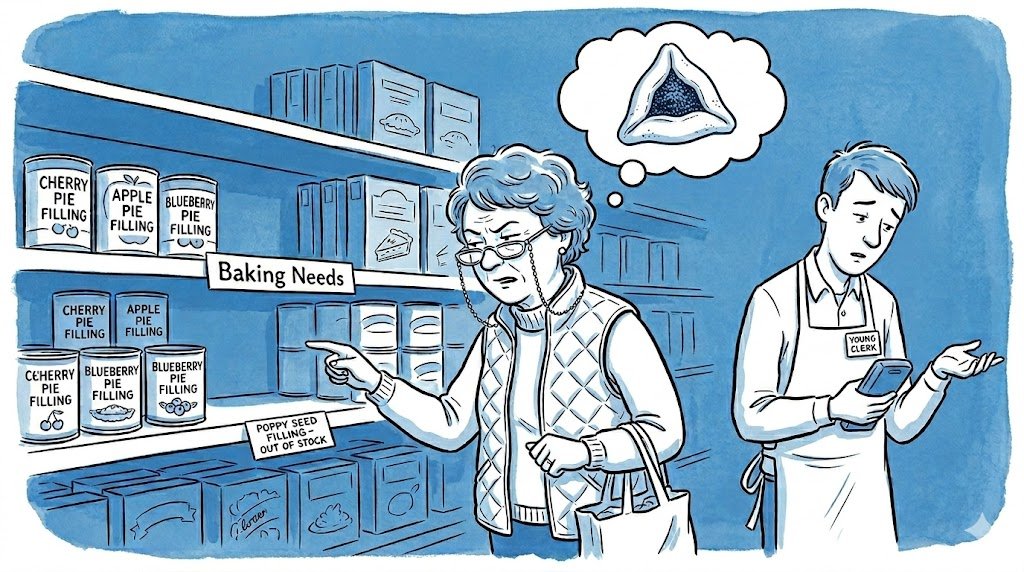
Barbara first sensed that something was wrong in the baking aisle at Kroger.
The baking aisle at Kroger presented itself with its usual air of domestic orderliness. Shelves stood neatly arranged beneath the bright overhead lights, their contents aligned with reassuring precision. Pie fillings occupied their customary positions, labels facing outward in cheerful rows of cherry, apple, and blueberry. Nothing appeared disturbed. Nothing appeared unusual.
She paused before the display, tilting her head ever so slightly. Barbara examined the shelf more closely. Cherry. Apple. Blueberry. But no poppy seed.
Barbara leaned closer, scanning the display again with careful concentration. Poppy seed filling had always been here. For years — decades even — it had occupied its modest but dependable space among the pie fillings. It was not exotic. Not rare. It was simply understood, like gravity or winter or the inevitability of Purim.
She moved slowly along the shelf, eyes narrowing, convinced the cans must have been misplaced. Grocery stores had a way of rearranging reality without warning. But as Barbara reached the end of the display, a peculiar unease began to settle into her chest.
There was no empty space. No tag. No sign that poppy seed filling had ever existed. The absence felt deliberate.
Only an hour earlier, Barbara had been seated comfortably at her kitchen table, smiling into the glowing screen of her iPad. Her grandson’s, Asher, face had half filled up the screen and sideways, and Barbara noticed that he hadn’t wiped away the cream cheese from the corners of his mouth.
“Gaga when are we making the Hamataschen” he asked.
Barbara had a well-known recipe passed down from her Grandma Ida. Every year, those lucky enough to receive a Mishloach Manot basket from Barbara would taste Grandma Ida’s famous Poppy seed Hamantaschen. Her secret ingredients – Cristco and Solo Poppyseed filling.
“You are coming on Sunday, Asher. I told your mom this. And you are going to be on your best behavior, right? Because we are baking, and I don’t want you to burn your hands in the oven. Last time, you got too close. Do you know what happens if you put your hands in the over, Asher?” asked Barbara.
“No,” replied Asher.
“You’ll burn your hands, and they’ll have to chop it off at the hospital. You don’t want that, do you?”
“No Gaga, I want to keep my hands,” said Asher.
“Good. I’ll see you on Sunday, and please tell your mom that I want you to wear something nice and there’s no cream cheese stains on your shirt, Asher. In fact, tell your mom to bring back up clothes just in case.”
Barbara, recalling this exchange, experienced a mild but distinct unease. Her friends, her grandson and her Facebook page were depending on her world famous Hamantaschen. Barbara, determined not to let this injustice ruin her holiday, found an unsuspecting store clerk.
He was young — impossibly young, Barbara thought — with the distracted expression that comes with the work ethic of the young people these days. She explained what she was looking for, her voice commanding, though she could already feel that this was not going to pan out.
The clerk scanned the shelf – even though Barbara had just done that earlier. After finally believing Barbara that it was not on the shelf, he consulted his device. Then delivered the words with a casualness that struck Barbara as deeply unnatural.
“We don’t stock it anymore.”
For a moment, Barbara did not respond. The phrase lingered in the air between them, heavy and unresolved. Grocery stores did not simply stop stocking poppy seed filling in late February. Not here. Not now. The timing alone felt wrong. Had Haman come back from the dead and infiltrated Kroger? Maybe one of those Gen Z kids thought it was an Israeli product and thought to boycott it? Either way, Barbara found this injustice unacceptable.
“Do you know that the Jewish holiday Purim is on Monday,” Barbara said carefully, “Considering how many Jews live here, this is just ignorant. Honestly, can I speak to a manager? At least someone older?”
The clerk hesitated. But he called a “Code 10 to aisle 20”, which Barbara then heard over the announcement speakers. Finally, someone who looked like they knew something had come to speak to Barbara. After hearing the whole situation, Mike, the manager, explained they could attempt to order it.
Barbara pressed for details, her questions growing sharper, more urgent. When would it arrive? Was there an estimate? Could another store be checked? Sunday was approaching. The grandchildren were coming. The baking had already been promised.
But Mike didn’t know and he couldn’t promise her anything.
Barbara was astonished. She walked back through the store with the strange, hollow sensation of someone leaving behind something unfinished. The world outside Kroger seemed unchanged — traffic passing, carts rattling, ordinary life continuing with unsettling indifference.
Yet Barbara could not shake the feeling that something had shifted. This was not a mere inconvenience. The poppy seed filling had disappeared.
