Cincinnati Punches Above Its Weight on SB 87
Most legislative hearings are exactly what you’d expect. Lawmakers move through agendas, staffers shuffle papers, and bills advance with little drama. The Ohio Senate Judiciary Committee hearing on Senate Bill 87, delayed by a winter storm and held on February 11th, followed that familiar script. In just over thirty minutes, legislators addressed measures involving catalytic converters, firearms reporting requirements, and probate estate fees. SB 87 came last.
The bill would expand Ohio’s ethnic intimidation statute by enhancing penalties for criminal offenses proven to be motivated by bias. It would also incorporate the International Holocaust Remembrance Alliance (IHRA) working definition of antisemitism into state law — a move supporters argue reflects evolving patterns of antisemitic incidents, while opponents warn carries broader implications.
Despite the intensity of the public debate surrounding the legislation, the committee’s discussion itself was restrained. The bill occupied roughly twenty minutes of hearing time. Lawmakers posed no substantive follow-up questions. Chairman Nathan Manning offered only a brief clarification, noting that the legislation had been updated to include examples drawn from testimony.
Yet the hearing revealed something notable.
Fourteen pieces of written testimony were submitted, accompanied by three individuals appearing in person. Of those testimonies, four originated from Cincinnati — the largest showing from any single Ohio city. For a mid-sized Jewish community, Cincinnati once again punched above its weight. If Ohio’s Jewish institutions had a Robert Kraft — consistently present, reliably engaged, and quietly influential — Cincinnati would make a compelling case.
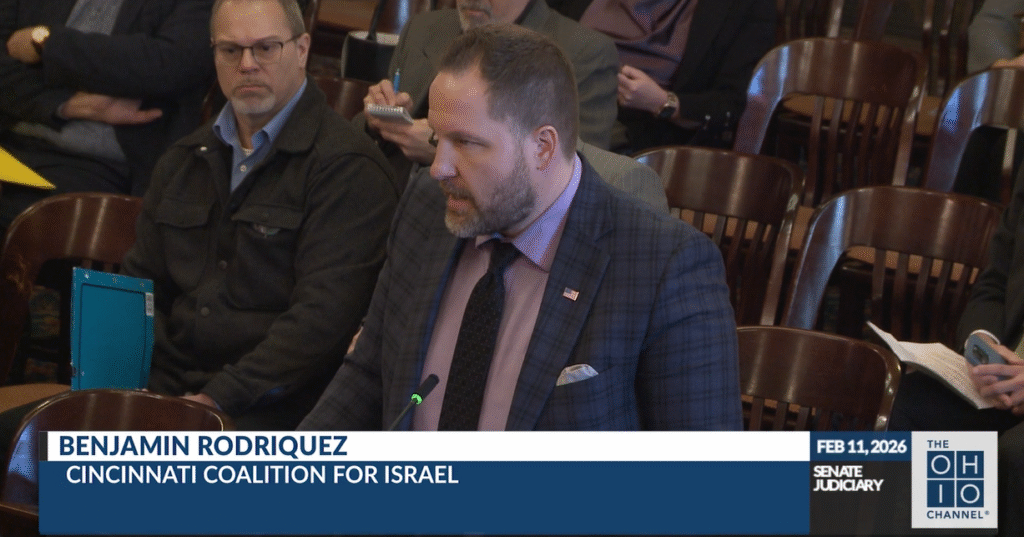
Among those testifying was Ben Rodriguez of the Cincinnati Coalition for Israel.
Rodriguez framed the legislation as a response to what he described as a growing pattern of antisemitic behavior. “The exponential rise of incidents motivated by antisemitism… demands decisive legislative action,” Rodriguez stated. “The only effective means to halt this disturbing trend is through the establishment of a clear law that serves as a genuine deterrent.”
Opposition to the bill has been hard to miss.
In the days surrounding the hearing, activists could be seen campaigning against SB 87 throughout the Statehouse corridors. The criticism extended well beyond formal testimony, reflecting a coordinated effort among advocacy groups opposed to the measure. Organizations including the Council on American-Islamic Relations (CAIR), American Muslims for Palestine (AMP), Jewish Voice for Peace (JVP), the Party for Socialism and Liberation (PSL), and regional activist coalitions have publicly aligned against the bill.
Supporters view the legislation differently.
Governor Mike DeWine’s 2022 executive order directed state entities — including public universities and agencies — to use the IHRA definition as administrative guidance. It does not, however, apply to criminal prosecutions involving private individuals. Supporters argue SB 87 would extend those considerations into statutory law.
One example of the kind of incident SB 87 seeks to address occurred in June 2025, involving Congressman Max Miller. In a 911 call released by the Rocky River Police Department, Miller described the encounter: “My name is Congressman Max Miller. I was just driving to work, and I was cut off by a man in a Tesla who held up a Palestinian flag to me and then rolled down his window and said that ‘I’m going to cut your throat and your daughters.’” The allegations resulted in a criminal complaint for aggravated menacing — not a hate crime.
The February hearing represents only an early step in the legislative process. Lawmakers are expected to hear additional testimony from opponents at a future Judiciary Committee session, though a date has not yet been set. The bill would then proceed to the full Senate for consideration and a vote. A similar measure previously passed the Senate but ultimately died in the House without receiving a floor vote.
Whether SB 87 follows the same path remains to be seen.
With the legislation advancing, Cincinnati-based organizations — including the Jewish Federation of Cincinnati and the Cincinnati Coalition for Israel — are encouraging members of the community to prepare testimony ahead of anticipated Senate proceedings. Advocates for the bill are also urging constituents to engage directly with lawmakers, with legislator contact details and suggested language made available online.
