Ira Kohler Speaks at Adath
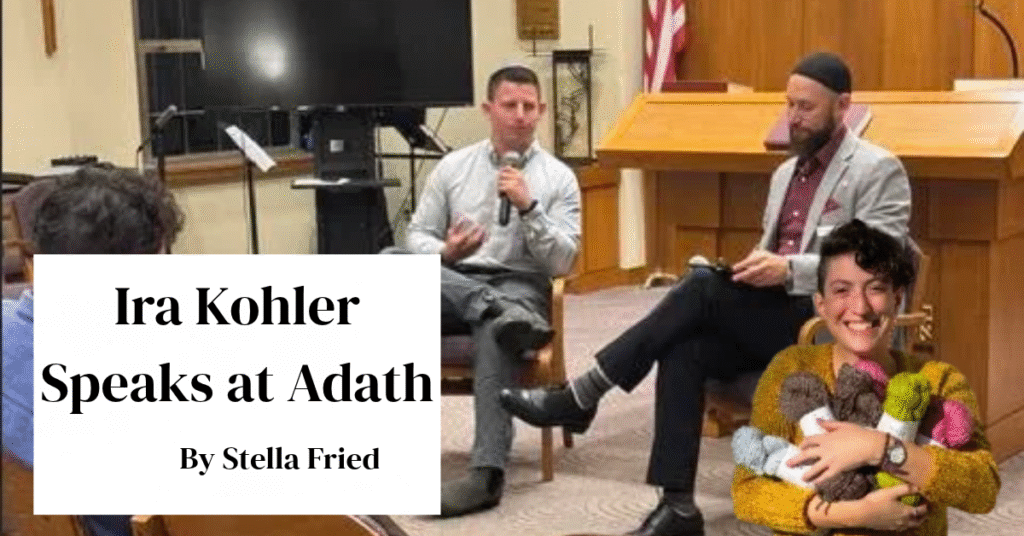
Ira Kohler is a warm, welcoming human being. He is an open, honest person who welcomed his audience in and invited us to ask (almost) any questions we had. He opened the evening by sharing a little about his book and how he chose to start it with a Shabbat dinner to unite readers and welcome them into his world. He shared a little about his experience as a lone soldier with Garin Tzadal and the camaraderie and friendships he developed with the sixteen other lone soldiers in his garin.
Interestingly, although most lone soldiers come from outside Israel and thus have no parental support in the State, Israeli orphans and Ultra-Orthodox Israelis that leave their families to serve in the IDF are also considered lone soldiers and often get many of the same benefits that traditional lone soldiers like Ira are given.
Ira went on to talk about how, coincidentally, he and his battalion already had their bags already packed the morning of October 7th. They were supposed to begin a war simulation that day and had packed their bags the night before. This enabled Ira’s group to be, albeit unintentionally, extremely prepared for heading into real combat. Since Ira’s battalion was in central Israel, they were quickly squeezed in to four helicopters, about fifty people per chopper, when these choppers normally held between 20-30 people each.
Ira’s chopper was supposed to land at Kibbutz Nachal Oz, but the pilot thought it seemed odd that there were so many people out around the kibbutz, so instead they were headed for Kibbutz Alumim when the chopper was shot down. The pilot made an emergency landing in an open field, and miraculously, everyone made it out of the chopper before it exploded due to rocket fire. If that wasn’t miracle enough, no one on Ira’s downed helicopter was killed in the ensuing gunfight with Hamas.
After the gun battle, Ira said, his battalion headed to Kibbutz Be’eri. They were the first major battalion to arrive at the kibbutz on October 7th, getting there at about 1:30pm. Prior to their arrival, there were only some police and kibbutz security defending Be’eri from Hamas. Soon, special forces arrived with tanks, so Ira’s battalion shifted to rescuing families.
Ira said rescuing the families of Kibbutz Be’eri was the greatest example of Pikuach Nefesh; nothing was more important than protecting them both physically and emotionally. The IDF circled around families as they led them out of the kibbutz, both to protect them from stray gunfire, but also to shield them from the horrors in the kibbutz. Ira felt encircling them also showed the families of Be’eri that the IDF cared for them and their mental and physical safety.
Ira also talked a lot about his friendship with October 7th victim Omer Neutra. They had grown up in the same community in New York, and how the hope that Omer was still alive in captivity, perhaps even celebrating his birthday, which was one week after the attack, helped Ira move forward in the Gaza war. Even after it was confirmed that Omer had been murdered on October 7th, Ira still thought of him often during the remainder of his service.
Although Ira’s service ended in January 2024, he chose to stay on in the reserves until March 2024. It was then that he returned home to America and began typing up everything he’d written in his journals while abroad, which eventually turned into his book “Ira Kohler: Once a Paratrooper”. Ira ended his talk by asking people to remember that the IDF are not heroes or villains, they are just human beings.
The event ended with a book signing, lots of kind words, and an incredible moment of Besheret. One woman had purchased a used copy of Ira’s book through Amazon and ended up with the copy Ira had personalized for his grandmother! She’d accidentally given that copy to a friend and then it was reunited with Ira hundreds of miles away. It was a really touching moment and reminded all of us that the Jewish community is always connected, and that we will always find a way.
Interview:
Tell me a little bit about your childhood. Had you always really thought about joining the IDF? So, a little bit on me, I grew up on Long Island, grew up very much in the heart of the Long Island Jewish community. I’d say my childhood is really, you know, designed by the Jewish institutions that shaped who I am I went to the Schechter school on Long Island. I was very involved in my synagogue, another conservative synagogue, just like Adath Israel. I went to the Young Judea summer camps every summer. All these different institutions really shaped who I am. And when I went to college, I went to University of Delaware, I then decided that I really didn’t want to do that anymore, that I wanted to go enlist and serve in the IDF. And I decided to finish my degree, and after finishing, that I would go and move to Israel. And so, in the summer of 2021, I moved to Israel to serve in the IDF.
Did you have any inspiration? Was there a person you met, or did you read something that inspired you to join the IDF? There was no single person or moment. In my book, I actually write about this, how, when people oftentimes ask me, you know, why I moved to Israel and enlisted in the IDF. They kind of, like, expect this aha moment. As if there was one moment or one person that, you know, inspired me to move, and the fact of the matter is that the decision was ultimately from a fabric, which is who I am, in my upbringing. As far as to who inspired me, you know, just meeting Israelis throughout my life and seeing and serve our state, and the soldiers themselves, I really want to be a lot like them, and to serve.
What was your experience like as a lone soldier? So, obviously, a lone soldier is someone serving in the Israel Defense Forces that does not have parental support, living in the state of Israel. And because my parents are here in America, and I was in the IDF, I was considered a lone soldier. One of the challenges is, you know, when you’re outside the army, where do you go for Shabbat and holidays and just to, like, you know, be? And I went to Israel through a program called Garin Tzadal. It’s a program, to basically help lone soldiers, just like me, need new to Israel, get acclimated to Israeli society, prepare for the IDF. And essentially it also just gives us a home. We moved to Israel and started a group that was seventeen North Americans all doing the same thing, and we lived on kibbutz Erez. We were given a host family when we were there, and we had this community of lone soldiers, and we also had a family we went to for Shabbat and on holidays.
I’d like to hear a little bit about your experience, on October 7th and the direct aftermath. On October 7th, I went to the Gaza Envelope where the war was happening. And a majority of what we were doing was fighting in Kibbutz Be’eri, which was really one of the epicenters of the October 7th attack. We fought there for many hours against
terrorists, and we also rescued a lot of families from their homes. And then after that, we prepared to go into the Gaza strip, and a few weeks later, entered Gaza.
Tell me maybe a little bit about your experience in the Army? Is there a reason you wanted specifically to be a Paratrooper? I wanted to serve in a combat unit. And I also really wanted to be in an infantry unit. There are 5 main infantry units in the IDF. Usually what attracts a person to a certain unit is the type of person you are. Each unit has their own culture, and I was very attracted to Nahal, who are the paratroopers, and the paratroopers are the only unit of the five that require a tryout. So, I got accepted to try out, and then I became a paratrooper.
What was your experience writing the book? Was it hard for you to write about those things? Did it feel freeing? When I was in Israel, when I was serving in Gaza, I wrote a journal every single day. When I finished my service, I typed up everything I wrote in the journal, and it ended up being a huge, huge document. I started to write about that and other experiences I had and eventually I decided to turn it into a book. Was it hard at times? Yes. But I think the hard part had so much of my story I wanted to write, and I wanted to make sure that everything was written down, and so that was just a challenge to make sure I got to say everything I wanted to say.
Finally, any advice you have for anyone maybe thinking about going into the IDF? Like I tell everyone, if you want to enlist in the IDF, if it’s a thought of yours, do it. Like, this is your chance in your life. It is an incredible opportunity that also comes once in a lifetime. Like, if you don’t kind of, you know, take advantage of doing it when you’re young, you really can’t do it when you’re older. And so, if you’re thinking about it, if you feel like it’s what you want to do, then follow your heart.
