Coffee, Bagels and Israel’s Last Line of Defense
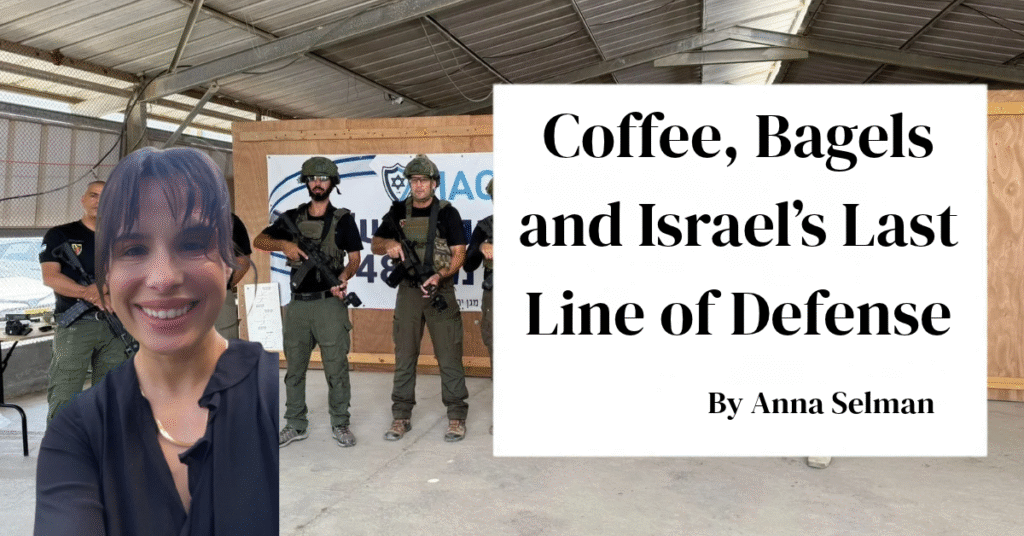
CINCINNATI – October 11 was a dreary, rainy morning in Cincinnati, but inside the house, hot coffee had been brewed and the finest offerings had been laid out in anticipation. The host warmly welcomed friends as they arrived one by one, helped themselves to bagels and spread out through the house. They had been invited to meet Ari Briggs and hear about the work that had brought him to Cincinnati: preparing Israeli communities to defend themselves.
Briggs had come straight from morning minyan, where he had spoken the day before as part of his Shabbat weekend visit. He was introducing Magen 48, an organization he co-founded to train civilian first responders in firearms proficiency, emergency medical response and crisis management. Over coffee and bagels, the guests would hear how that work grew out of one kibbutz’s defense on October 7—and why Briggs believed its lessons could help protect other communities.
There was something familiar about the setting, echoing the parlor gatherings before the war in ’67. Since October 7, this is often how Israel advocacy has taken shape: someone opens a home, brings friends together and makes an introduction, drawing a connection between the needs of communities in Israel and what people in Cincinnati might do to help.
As Briggs tells the story, the project grew out of Kibbutz Erez, a small community near the Gaza border that produces thermoplastics. On October 7, its security team fought for hours and repelled the attack. The community avoided the devastation suffered by others nearby.
Visiting afterward, Briggs asked a resident why Erez had fared so differently. The answer was a name: Ehud Dribben.
A counterterrorism expert, Dribben had spent months before October 7 training the kibbutz’s volunteer responders. Residents credited that preparation with helping them defend their community. Whatever combination of skills, discipline and coordination he had taught them, it worked when they needed it most. Briggs enlisted Dribben, who was already motivated to return to the work, to bring that preparation to other Israeli communities.
The threat Briggs described extended beyond Hamas’s organized fighters. He said Hamas had encouraged others to cross into Israel and join the assault.
“They were playing on the loud speakers for people to come join the ‘jihad,’” Briggs said. “And civilians did, and in many cases, they were more brutal then the Hamas fighters themselves.”
What Briggs described was the mobilization of radicalized civilians as a force multiplier: encouraging more people to participate in an assault than the trained fighters who launched it. His account suggests how that mobilization could expand Hamas’s capacity to overwhelm communities.
What he and Dribben are building offers a different answer. Training and education can become a defensive force multiplier, preparing more residents to protect their neighbors and respond together. Dribben conducts training in the towns themselves. Residents practice on the terrain they would have to defend, alongside the people they would depend on. They learn how their team works in the place where that coordination would matter most.
“Civilian line of defense is the last line before the community falls,” Briggs said.
According to Briggs, 300,000 Israelis have obtained pistol licenses since October 7, creating a growing demand for the kind of training Magen 48 provides. For many of these new gun owners, the responsibility of carrying a weapon has brought a further question: would they know how to use it when their community needed them? Magen 48 currently has access to IDF live-fire ranges, he said, but Briggs and Dribben hope a facility of their own will allow them to train more civilians more quickly.
That ambition is taking shape at Kibbutz Re’im, close to the site of the Nova massacre, where Briggs said they are planning what he called the Center of Resilience. Along with its own live-fire range, the proposed facility would offer emergency medical training and simulated attack scenarios, with a memorial hall honoring the civilian first responders killed on October 7.
The location gives the project a particular weight. Since the massacre, the nearby Nova memorial has drawn visitors from Israel and abroad to remember those killed and confront what happened there. There is something unsettling about a place becoming so widely visited because of the horror it witnessed. Briggs and Dribben’s project would bring people to the area for another purpose as well: to learn the skills that could help their communities survive another attack.
For now, building that center means bringing the story to gatherings like this one in Cincinnati, where a host had opened a home and invited friends to listen. The distance from Re’im was considerable, but the warmth of the reception had stayed with Briggs.
“Cincinnati is the smallest community I’ve been to so far, but its the most heartfelt,” he said.
