Rewrite the Story I’m Telling Myself
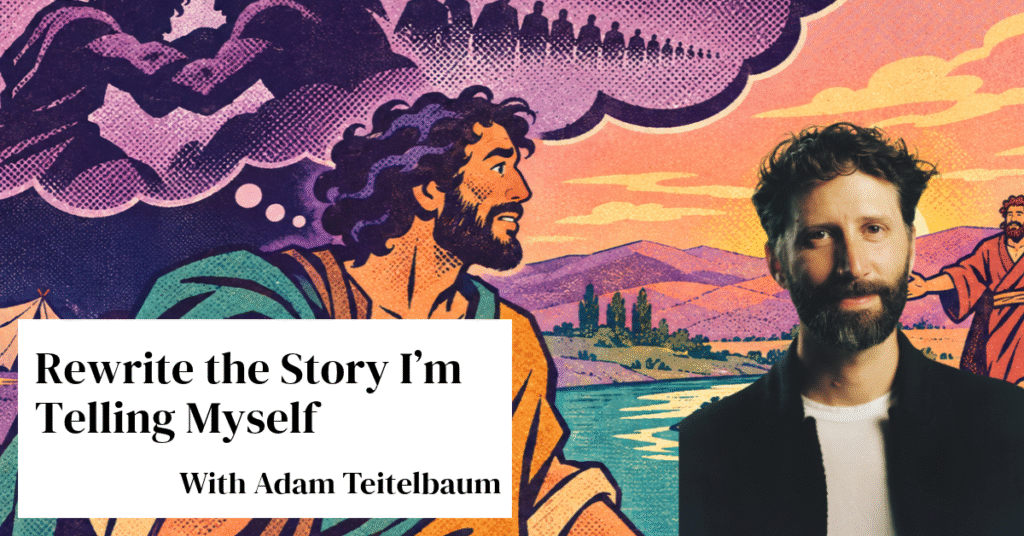
It is a bit embarrassing to think about the number of times I’ve procrastinated sending a difficult e-mail or making a phone call, owning up to a mistake, all because I’d created an entire worst-case-scenario narrative in my mind. This happens to me all too often in marriage and parenting. There is some internal dialogue happening in which I completely work myself up into a paralyzing tizzy of epic proportions. Based entirely on the perception that I’ve $*&#ed up, someone has caught me, and I want it to be THEIR fault rather than mine. I’m exaggerating a bit, but this is a head-talk sample.
So what can I do? How do I not only break out of that moment so I can begin the healing process, but break the cycle so I don’t fall prey to the same self-protective (and potentially outwardly harmful) pattern?
One of my gurus, Dr. Brene Brown, has a phrase for this: “The story I’m telling myself.”
What a remarkable tool to use when broaching the topic pre-email, pre-phone call. “Dear X, it is entirely possible that what I’m about to share is completely in my own mind. The story I’m telling myself is … If that’s just in my mind, I hope that it wasn’t off-putting for me to share this. And if it is in fact true, I would cherish the opportunity to course correct and make amends.”
What I love about this week’s Parsha, Vayishlach, is that the Torah gives an insight into Jacob’s vulnerability and insecurity. We can take comfort in the idea that, if a man as accomplished and remarkable as Jacob still has these kinds of “story I’m telling myself” doubts, and can work through them, we’re in excellent company.
As Jacob prepares to meet Esau, the Torah gives us a rare window into a man struggling under the weight of his own story. Twenty years earlier he fled after taking Esau’s blessing, and somewhere inside he still wonders whether the consequences have finally caught up with him. When he hears that Esau is approaching with an army of four hundred men, Jacob assumes the worst—not because he has evidence, but because he has a script. Maybe I deserve whatever is coming. Maybe Esau has every right to destroy me. Maybe this is the moment my past overtakes my future. So he works feverishly to manage the imagined disaster: sending extravagant gifts to soften Esau’s anger, dividing his family in case one camp is attacked, and—according to the Rashbam—preparing to run away altogether. It’s the paralysis of the familiar narrative: I did harm; they noticed. And then, on the eve of the encounter, Jacob is forced into a struggle with a mysterious figure. Whether angel, adversary, or the embodied shadow of his own fear, the wrestling is real because the fear is real. He is grappling not with Esau but with himself—his guilt, his worthiness, his terror of facing what he cannot control. By dawn, wounded but standing, Jacob receives a new name, Yisrael, “he who wrestles with G-d,” and with it the clarity to see that the disaster he anticipated is not inevitable. He can walk toward his brother not as a fugitive of his past but as someone who has finally confronted it.
Just as Jacob doubts he will be safe and protected, a baseless fear because G-d has already promised him as much – and because these fears stem from his own perception of a yet-to-happen reunion with Esau – too often the obstacle is in our own minds. Those well worn neural pathways come from all sorts of different places: childhood, early career experiences, relationship drama, trauma. What is most important to becoming a successful father and partner, as I am learning, is the ability to identify when the story is purely a reflection of my own fear of vulnerability and imperfection. I have to learn to see that the story is hog-tying my ability to interact meaningfully. This is the danger of storytelling when there’s no audience? At least, from the story I’m telling myself NOW.
