Opponents Flood Ohio Senate Hearing on Israel Trade Partnership Bill
COLUMBUS — Opponents of House Bill 188 outnumbered supporters at a May 12 Ohio Senate Finance Committee hearing on the state’s proposed trade and innovation partnership with Israel. HB 188 was introduced by Rep. Thomas Hall and Rep. Eric Synenberg last year. The bill passed the Ohio House in November by a vote of 73 to 10. The May 12 session was the bill’s second hearing before the Finance Committee, chaired by Sen. Bill Cirino. The bill would establish a 17-member commission to strengthen economic, academic and technological collaboration between the two states.
The Jewish Community Relations Council (JCRC) of Cincinnati, the non-partisan public affairs arm of the Jewish Federation of Cincinnati, mobilized supporters the day before the hearing, posting a call to action on social media urging constituents to contact their representatives in favor of the bill.
Five proponents testified, including Rick Carfagna of the Ohio Chamber of Commerce, Ori Katzav and representatives Aaron Abel and Daniel Pearlman of the Jewish Federation ofColumbus, and a representative of the Jewish Federation of Cleveland. Carfagna cited existing trade ties, noting Ohio exported nearly $242 million in manufacturing goods to Israel in 2023 and that Ohio ranks 12th among all states in exports to Israel, with total exports since 1996 exceeding $6 billion.
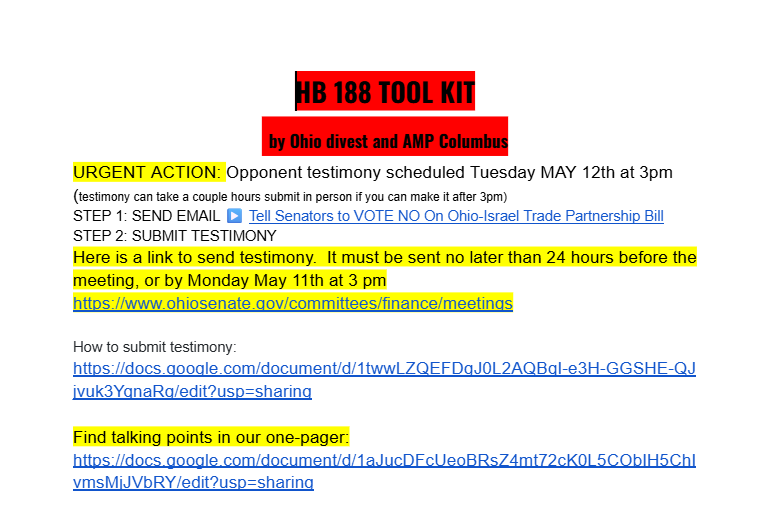
The opponent side was larger and more organized. In the days before the hearing, a toolkit prepared by Ohio Divest and AMP Columbus (American Muslims for Palestine) was circulated through Council for American Islamic Relations (CAIR) Ohio’s social media. The document contained prepared talking points, call scripts, and suggested testimony language. Multiple phrases appeared nearly verbatim in testimony delivered at the hearing,including language about a lack of “measurable return on investment,” missing “security protections,” and the risk of “misuse of taxpayer funds.”
Former FBI investigator David Collins recently briefed Cincinnati Jewish leaders that the networks behind the opposition (AMP and CAIR) are connected to the American Muslim Brotherhood. In 1991, the Brotherhood issued its “Explanatory Memorandum on the General Strategic Goal for Group in North America,” a document discovered in an FBI raid that outlined a long-term project for the Islamization of America.
Opponents raised a range of objections, from procedural concerns about oversight and accountability to broader opposition rooted in the conflict in Gaza. Samantha Baker, testifying for the Communist Party USA, called the bill “vague, unnecessary and wasteful.” Sezny Watkins, who identified herself as Jewish, said opposing the bill “is not a no vote for Jews, but a vote against tying ourselves to trade and economic support for vast human rights abuses.”
The most pointed testimony came from Charles Abernathy, a former Ohio Department of Health employee, who directed his remarks specifically at the Black lawmakers on the committee.Abernathy singled out Sen. Hearcel Craig, Sen. Paula Hicks-Hudson and Rep. Catherine Ingram by name, accusing them of allowing their “Black face” to be “used to profit Zionism, a form of white supremacy.”
Chairman Cirino pushed back on one speaker who suggested lawmakers were prioritizing Israel’s interests over Ohio’s, calling the insinuation “patently absurd.” The speaker replied:”Thank you, but I don’t agree with that.”
No committee vote has been scheduled as of date. “Proponents made the case for Ohio’s competitive position, and we share their view. What also deserves attention is the opposition. Much of last week’s testimony came from talking points circulated by national activist networks. When testimony singles out threeBlack lawmakers by name and accuses them of being ‘used to profit Zionism,’ that is bigotry. We urge the Senate Finance Committee to advance the bill on its merits,” said Chandler Waite, Director of the Jewish Community Relations Council (JCRC) of Cincinnati.
