Northern Row Brewery
Looking around the block, the large brewing vat outside the old brick building now home to Northern Row Brewery immediately draws the eye. Striped window coverings printed with craft beer names and expressive faces add personality to the façade. But it is the faded lettering still visible high on the exterior wall—Apex Furniture Manufacturing Company—that hints at a deeper story. Buildings, like people, accumulate histories, and the older they are, the more layered those histories become.
Research into the structure’s past reveals a story that goes far beyond beer and brick. The Apex Furniture Manufacturing Company was founded by Israel and Florence Seibert, Holocaust survivors who each endured more than four years in Nazi concentration camps. In 1952, Israel chose Cincinnati in part because the presence of Hebrew Union College signaled that Jewish life in the city was vibrant and secure. Encouraged by the opportunity to rebuild within an established Jewish community, the couple resettled here and gradually established a business that would contribute to the region’s economic life and intergenerational stability.
An interview with Florence Seibert, conducted by the Jewish Holocaust Survivors of Cincinnati chapter, is preserved at the US Holocaust Memorial Museum. Their story is one of extraordinary resilience. After systematic dehumanization, their lives in Cincinnati did not end in victimhood but became testimony—Baruch Hashem (“blessed be God”)—to the sustaining power of faith, work, and community. The faded sign on the building’s façade is more than an artifact; it is a quiet marker of survival and renewal.
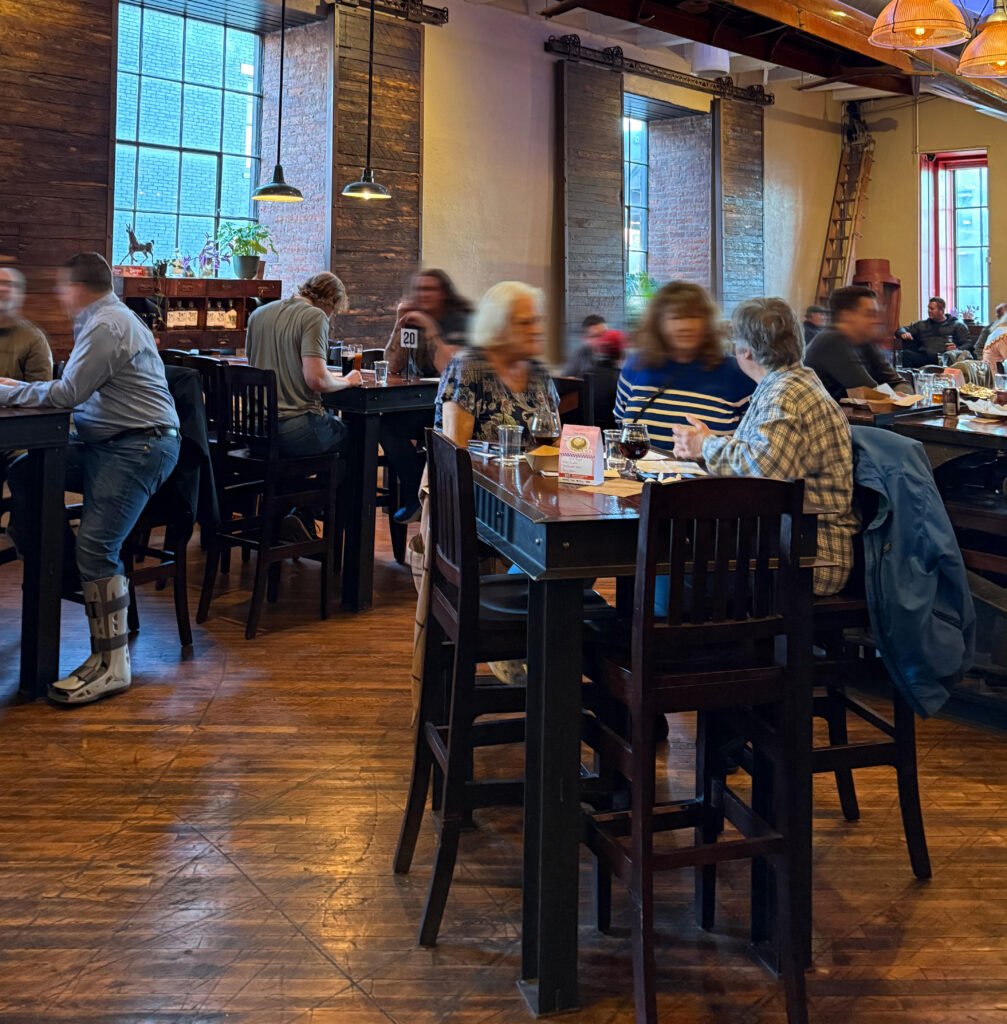
Today, the building carries that legacy forward in a different form. Its recent repurposing as Northern Row Brewery integrates indoor and outdoor spaces while preserving architectural character. Inside, bartenders move briskly behind a grand antique bar illuminated by warm, carefully chosen fixtures. Along one exterior wall, large wooden shutters hang from a top-mounted roller rail, adding texture and warmth. Memorabilia from Cincinnati breweries such as Burger, along with antique games, reinforce a cohesive interior design that blends industrial heritage with neighborhood comfort.
On the evening of my visit, the brewery was especially crowded. Beer flights were unavailable due to the large turnout for Precipitation Retaliation, a Bockfest tradition begun in 2009 and performed annually in hopes of keeping the festival’s skies clear. The ritual includes the ceremonial burning of Frothy, a snowman constructed from semi-flame-retardant materials. A priest-like figure and his flame-costumed assistant led the spectacle, drawing cheers from the gathered crowd.
Instead of ordering a flight, I sampled three beers individually. Hustler, a Helles, poured a pale straw color and delivered exactly what the style promises: light, crisp drinkability with subtle malt presence. As the brewery notes, “Our Hustler Helles is a German-style light lager, traditionally brewed with all imported malt and noble hops.” Brewer, a light-amber Märzen, offered toasted malt character, gentle nuttiness, and smooth caramel sweetness, then finished clean and crisp. Cooper, brewed in honor of Cincinnati’s Bockfest, leaned spicier, with light citrus notes layered over rich malt depth and restrained hop bitterness. Each beer was balanced and stylistically sound.
The food held its own. The Chicken Wrap features house-roasted chicken, LK’s pepper bacon, tomato, red onion, mixed greens, and ranch dressing, delivering satisfying flavor in a generous portion. As the evening progressed and the noise level rose, conversation became difficult, prompting a move outdoors. Near the entrance to the patio, a display of award-winning bottled spirits stands beside a beer-to-go chiller. Walled off by a neighboring structure, the outdoor seating area forms a sheltered urban retreat, offering a quieter place to gather.
Warm, well-worn wood floors inside the brewery testify to an era when commercial buildings were constructed with durability in mind. The same structure that once housed a survivor-founded furniture company now anchors a thriving craft brewery. In that continuity lies something distinctly Cincinnati: a respect for labor, for adaptive reuse, and for community rooted in shared space.
The faded Apex sign remains visible overhead, a reminder that the present rests on foundations laid by those who came before. In a culture often eager to discard the past, Northern Row Brewery operates within it—pouring new life into old walls and inviting patrons, however casually, to participate in a longer civic story.
