Palestinian Activists, Covington Workers and the Kentucky Taxpayer
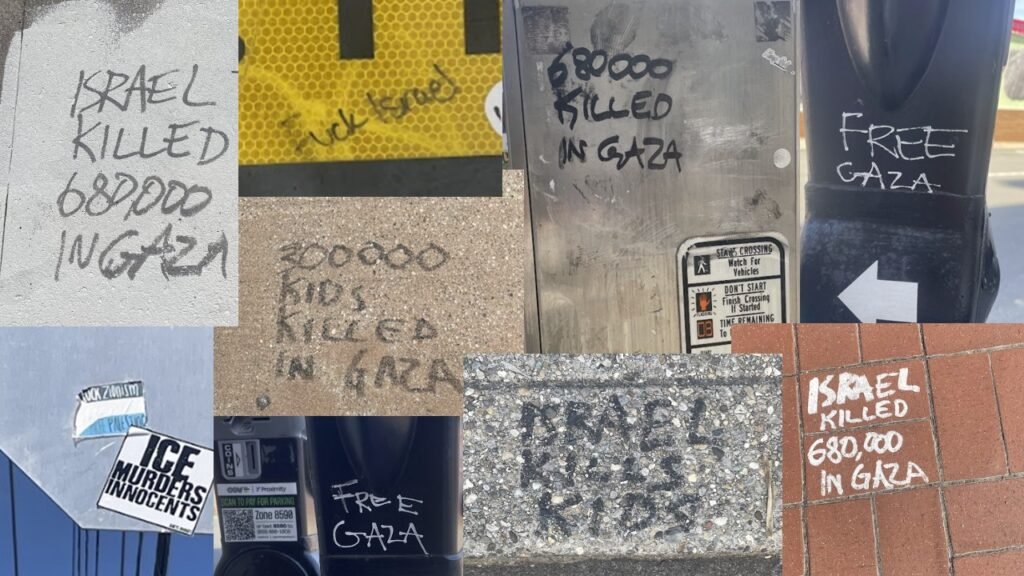
COVINGTON, KY — If you spend enough time around downtown Covington, you begin to notice a common theme plaguing the city’s streets. A slogan appears on a stop sign: Boycott Israel. A sticker shows up on a parking meter: Free Gaza. Painted text materializes on a municipal power box: 680,000 killed in Gaza. Then, a few days later, a city employee arrives with a scraper, a paint roller, or a replacement sign. The message disappears. The worker leaves. A week later, it starts all over again.
Since the October 7th attacks, pro-Palestinian activists have utilized Covington’s public infrastructure as a canvas to combat what they describe as Zionist influence in Northern Kentucky. While the activists view their work as part of a grand geopolitical protest, the immediate, daily reality has turned into an exhausting war of attrition for Covington’s public works crews. Local crews are relegated to cleaning up the graffiti with roughly twenty different recurring slogans—ranging from “Israel commits genocide” to escalating casualty claims like “300,000 kids killed.” These messages have continuously blanketed everything from fire hydrants and crosswalks to the historic Roebling Suspension Bridge.
Initially, the financial strain forced a logistical crisis for Covington’s municipal budget. According to public works staff, the chemicals in the activists’ markers permanently stripped the specialized retroreflective paint off municipal stop signs, forcing the city to completely replace them at $45 a piece. As these replacement costs began to strain the city’s resources, crews engineered a creative workaround: instead of replacing the metal backing entirely, they began covering the graffiti with blank vinyl stickers. While the color-matched red and yellow patches successfully saved the budget, it has left downtown Covington covered in plastic squares—a visual reminder of a continuous local chore.
However, the largest concentration of the graffiti has been centered around the historic Suspension Bridge, and the grander the target, the heavier the local fallout. In April, the Kentucky Transportation Cabinet was forced to close a traffic lane and a pedestrian walkway on the Roebling Suspension Bridge for two days so crews could sandblast the masonry. It marked the second time the historic bridge had to be shut down for graffiti removal, costing taxpayers another $20,000.
While state crews labored to clean the historic structure, the activist group NKY4Palestine posted a video to social media celebrating the infrastructure disruption, writing, “The truth is undeniable… we MUST keep speaking up.” Yet the specific figures painted across Covington, claiming 680,000 casualties, which bears no relation to even the Hamas-controlled Gaza Ministry of Health’s own reports. Within a month of the expensive $20,000 cleanup, those same exaggerated numbers reappeared on the stone.
All of this disruption has left local business owners and residents frustrated, and many point to a specific neighborhood bartender as the individual responsible for the ongoing vandalism. The suspect was previously captured on video confronting former Covington Vice Mayor Steve Frank on the pedestrian path of the bridge, explicitly threatening Frank and vowing to continue vandalizing the structure if Frank, who is Jewish, attempted to have the graffiti removed.
Kentucky was actually the first state in the nation to formally adopt the International Holocaust Remembrance Alliance (IHRA) definition of antisemitism. Under this landmark standard, targeting a Jewish public figure and fabricating mass atrocities can elevate standard criminal mischief to a felony ethnic intimidation charge. Yet, despite extensive camera coverage on the bridge and a clear suspect, the Kenton County Prosecutor’s Office has yet to announce any formal charges.
“We have been coordinating with prosecutors to determine the most appropriate charges,” said Captain Justin Bradbury, spokesman for the Covington Police Department, confirming that an active investigation is still underway.
While these activists loftily claim they are fighting a grand war against global Zionism, it isn’t international politicians or world leaders who have to answer for their actions. It is the ordinary, blue-collar Covington municipal worker. There is a profound, ugly irony in a movement that claims to champion human rights, yet deliberately forces working-class city employees to spend their mornings scrubbing away their vandalism. As the Kenton County Prosecutor’s Office remains paralyzed over where free speech ends and property damage begins, the grand geopolitical protest remains nothing more than a strain on Covington’s maintenance budget.
