Two Local Incidents Show October 7 Antisemitism Never Ended
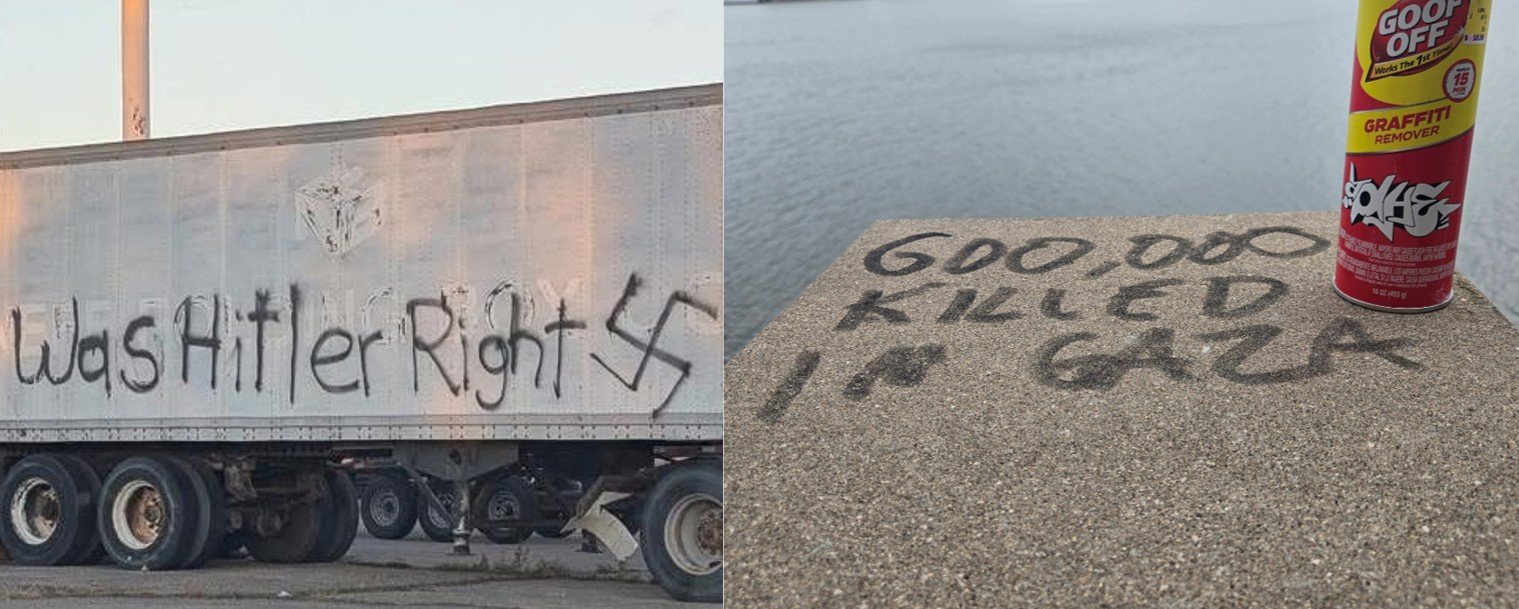
CINCINNATI – Two antisemitic incidents in our region last week made something unmistakably clear: what began on October 7 was not a passing wave of antisemitism. It is an ongoing environment—one that many hoped would settle down on its own but hasn’t. And the cost of that wishful thinking is becoming harder to ignore.
Over the weekend, a Jewish resident of Covington went to clean anti-Zionist graffiti plastered across the Roebling Bridge—graffiti that had sat untouched since October 7, 2025. It accused Israel and Zionists of the usual litany of crimes, the kind of language that blurs quickly into classic antisemitic tropes about Jewish power and malevolence. The city hadn’t removed it. Activist groups hadn’t objected to it. So a private citizen showed up with cleaning supplies.
While he worked, a man known in anti-Zionist circles approached him aggressively, shouting and behaving erratically. It was only when a passerby began recording that the man backed away. That is the climate we’re living in: Jews doing basic civic work now attract hostility simply because the word “Zionist” has become a cultural permission slip for confrontation.
The next day, in Middletown, someone spray-painted “Was Hitler right” with a swastika on an abandoned truck. No coded language. No room for interpretation. Just open, public celebration of genocide.
For months, some insisted this moment would “pass”—that if we kept our heads down, avoided conflict, and waited out the protests, things would go back to normal. But these incidents show the opposite. Once antisemitism was unleashed in the wake of October 7, it didn’t dissolve. It settled into the culture—on the extremes of the right, on the activist left, and in the middle spaces where people have simply stopped speaking up.
Young Jews feel this most acutely. Many say they were not prepared—emotionally, educationally, or communally—for a world where defending Israel’s right to exist, or even being openly Jewish, could provoke hostility. They grew up with universal messages about justice and healing the world, but far less grounding in Jewish particularism: why Jewish safety matters, why Israel matters, and why antisemitism is not an abstract historical idea but a present, active force.
Local incidents like those at the Roebling Bridge and in Middletown remind us that antisemitism doesn’t fade on its own. And silence doesn’t make us safer. What protects communities—ours or anyone else’s—is clarity, vigilance, and the confidence to name hatred for what it is.
This moment calls not for panic, but for honesty. October 7 is not behind us. Its aftershocks are still here. And we must prepare ourselves—and our children—to meet them with strength, knowledge, and an unshakable sense of who we are.
