Iran Is Not a Debate For the Persian Jews of Cincinnati
CINCINNATI – For many Jewish Cincinnatians, Iran exists as a headline—another distant conflict, another geopolitical problem to be debated and then set aside. For Persian Jews of Cincinnati, it is something else entirely. It is memory. It is exile. And for some, it is a home they can never return to.
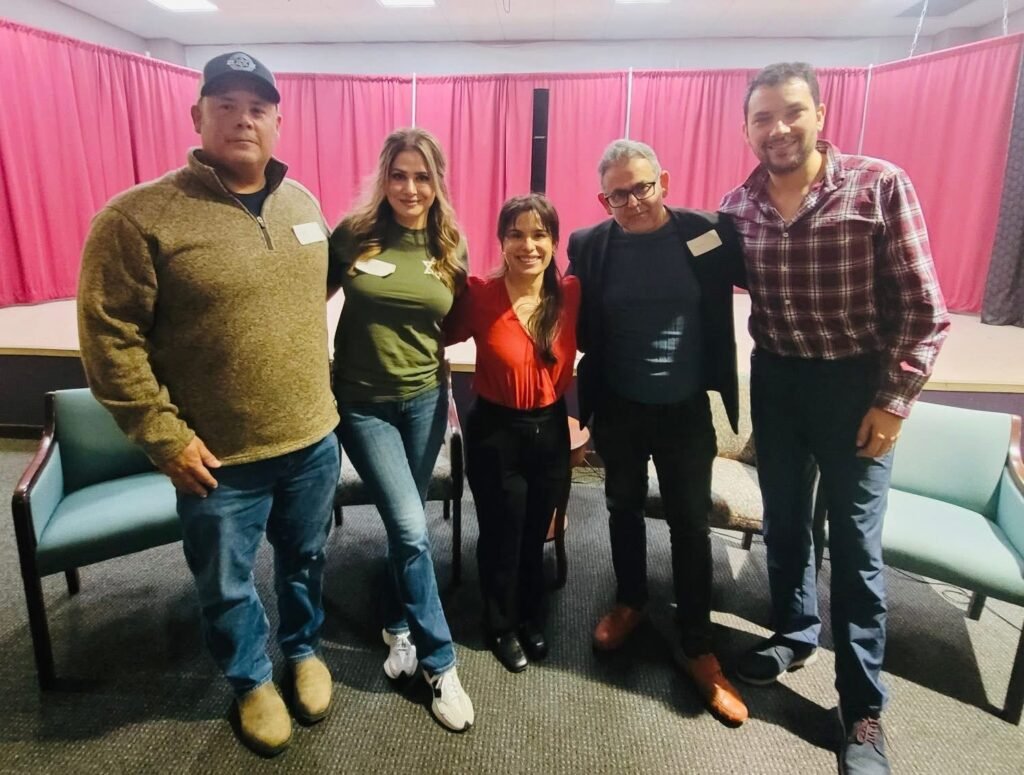
On Sunday, March 15, at Etz Chaim, Cincinnati’s Persian Jewish community gathered not to debate theory, but to tell the truth as they have lived it. The panel, moderated by Erica Cohen-Biscotti, featured Yarden Neeman, Mo Shaw, Shawn Nehorai and, briefly, this reporter. What unfolded was less a policy discussion than an act of testimony—the first installment of Etz Chaim’s MENA Voices series, an effort to elevate Middle Eastern Jewish voices within the Cincinnati community.
The program opened with Cincinnati’s shaliach, Tzach Shmuely, who offered a historical frame that underscored the urgency of the conversation. Iran, he reminded the audience, is still home to one of the largest Jewish communities in the Middle East outside of Israel. Which is to say—this story is not only about the past.
The audience reflected that urgency. Congregational rabbis sat alongside representatives from the Jewish Federation of Cincinnati, the Cincinnati Coalition for Israel, Jewish National Fund, advocacy groups, and Ohio State Representative Dani Isaacsohn and Representative Karen Brownlee. This was not a niche gathering. It was a room paying attention.
Yarden Neeman began with his grandparents, who left Iran for Israel in the 1960s. He described his grandfather visiting friends in the Persian community—welcomed in, invited to sit, even to eat. But with one condition: he could not touch the food others would later eat. If he did, it would no longer be considered permissible.
An audible gasp moved through the room. It was a small detail, almost mundane—but it revealed something larger. Discrimination does not always announce itself loudly. Sometimes it lives in quiet, repeated moments that define where you belong—and where you do not.
Mo Shaw followed with a story that stretched back even further. His grandmother arrived in Cincinnati in the 1920s, part of an earlier wave of Persian Jews who left Iran amid instability and uncertainty. Shaw described a document his family still keeps—a scroll outlining Sharia law. His grandmother kept it for a reason. Not as a relic. As a reminder. A reminder of the system they had lived under—and of what they had left behind.
If those stories reflected the past, Shawn Nehorai brought the present into the room. A local Persian rug dealer, Nehorai described leaving Iran on the last El Al flight from Tehran to Tel Aviv. But it was not his own escape that stayed with him most.
It was what is happening now. He spoke about the regime’s treatment of women, describing sexual violence as a tool of punishment and control. As he spoke, people shifted in their seats. The discomfort was visible. It was not the kind of story that allows for distance.
When it was my turn to speak, I described a different kind of Iran—the one that exists in memory and inheritance. My family left in 1979. I grew up in California, in communities where “Iranian” was not a single identity, but a shared culture. You could walk into a restaurant or a house party and find Jews, Zoroastrians, Baha’is, and secular Muslims sitting at the same table. It wasn’t remarkable. It was normal.
And then, almost overnight, that kind of coexistence disappeared. What replaced it is what the world now recognizes: a regime that defines identity more narrowly, enforces it more aggressively, and punishes those who fall outside of it.
At several points, audience members tried to steer the conversation toward politics—toward policy, alliances, and ideology. But the panel resisted that pull. Again and again, the focus returned to something more fundamental: human rights. That distinction was the point.
Because what became clear over the course of the afternoon is that Persian Jewish identity is often misunderstood—even within the broader Jewish world. It is frequently grouped together with other Middle Eastern communities, flattened into a category that misses its particular history and culture.
That difference was on display not only in the stories, but in the details of the gathering itself. The meal served—fesenjoon, kuku sabzi, tachin, and shirazi salad—offered more than hospitality. It was a reflection of a culture that has endured, adapted, and insisted on being remembered.
If the stories shared that afternoon were heavy, the response was not resignation. The community is not finished. They are preparing to gather for Nowruz, the Persian New Year, which this year coincides with Shabbat. At the same time, reports out of Iran described renewed crackdowns tied to Chaharshanbe Suri celebrations and the continued execution of political prisoners. The distance between celebration and repression is not theoretical. It is happening at once.
At Etz Chaim, there is already a sense that this cannot be a one-time conversation. Organizers are working to expand the MENA Voices program into a series, creating space for other communities—Moroccan, Iraqi, and beyond—whose stories are often left out.
Because what became clear in that room is that these stories do not end when the panel does. They are still being lived—here and there, all at once.
