CAIR Leader’s Graphic ‘Skin Bank’ Rant Rocks Ohio Senate During Antisemitism Hearing
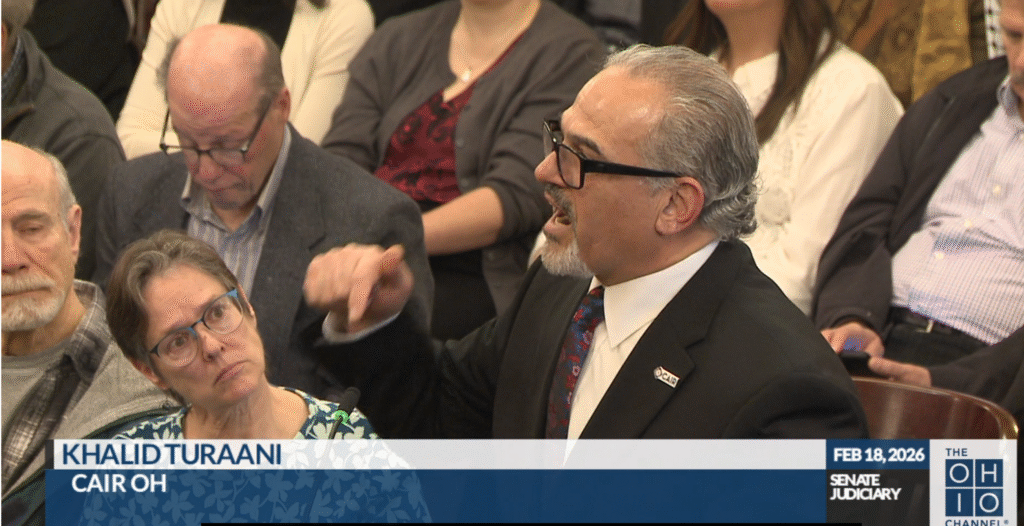
COLUMBUS — February 18th saw the continuation of the second legislative attempt to codify the International Holocaust Remembrance Alliance (IHRA) definition of antisemitism into state law. The hearing for Senate Bill 87 drew a wave of dissent, consisting of 67 testimonies from a broad coalition including the ACLU of Ohio, Council for American Islamic Relations (CAIR) Ohio, Jewish Voice for Peace (JVP), and the Ohio Poor People’s Campaign.
The dissenters opposed the formal codification of the IHRA definition, which is currently in practice via Executive Order 2022-06D, issued by Governor Mike DeWine. While DeWine’s order required state agencies and public universities to adopt the definition following a surge of antisemitic incidents, the order is set to expire at the conclusion of his term. Proponents of SB 87 argue that without codification, the protection of Jewish Ohioans remains at the mercy of future governors’ discretion. If enacted, Ohio would join at least 37 other states that have already codified the definition.
The push for a permanent statute began in late 2024, following a sharp rise in antisemitic activity across the Ohio Valley. Cincinnati has been a particular flashpoint, seeing cemetery desecrations, antisemitic graffiti targeting Jewish institutions, and Hamas iconography displayed in banners hung on interstate overpasses. In one of the most cited incidents, Jewish students were blockaded inside a Hillel building during a campus protest.
Opponents of the bill primarily argued that the legislation is redundant. “We already have laws that deal with discrimination and ethnic intimidation,” testified Sean Abbott-Klafter. “So why is this bill being advanced now?” Livui Bold echoed this sentiment, questioning the necessity of “picking favorites” when existing laws ostensibly protect everyone from intimidation.
Others directly challenged the use of the IHRA’s definition in particular. David Shutkin, testifying on behalf of Jewish Voice for Peace, said, “My opposition to Zionism is political and ethical, not antisemitic.” Gary Daniels from the ACLU argued against the definition as well, “this language does not cure SB 87 of the numerous constitutional headaches it causes and the belief SB 87 would ultimately target and punish constitutionally protected speech.”
Others, however, moved beyond procedural concerns to challenge the definition’s focus on Israel. Carole Gilchrist challenged the terminology itself, claiming, “I would like to challenge the word ‘antisemitism,’ being that the Palestinians are the Semitic people”—a common linguistic argument often used to deflect the term’s historical focus on Judeophobia.
The hearing took a sharp turn during the testimony of Khalid Turaani, who has served as the executive director of CAIR Ohio since 2025. Departing from his submitted testimony, Turaani invoked a modern variation of the blood libel, accusing Israel of harvesting organs.
“Israel has the largest skin bank in the world,” Turaani told lawmakers. “Where do you think they got all this skin from? They have more human skin than China and India. They are literally skinning the dead bodies of my brothers and sisters in Palestine… and if I call them Nazis, your law is going to punish me.”
The remarks drew visible shock in the hearing room and quickly went viral. While the testimony sparked immediate condemnation from groups like the ADL and the American Jewish Committee, no members of the Jewish organizations present for the dissent have yet distanced themselves from Turaani. As of press time, JVP Central Ohio continues to promote Turaani’s statement on social media.
“This kind of rhetoric only strengthens the reasons to pass this law. Turaani’s language is dangerous, and its false information,” said Darrell Radin from the Cincinnati Coalition for Israel (CCFI). “Any Jewish organizations still allying themselves with Turaani and others that made those horrendous allegations, I ask them if they support this Jewish blood libel?”
Currently, no date has been set for the next hearing for SB 87. Meanwhile, the Ohio Senate is also considering SB 200, which would create the Ohio Israel Trade and Innovation Partnership. That bill is scheduled for a sponsor testimony on March 4th.
