Building Strength in 2025: The Spiritual Books That Sustained Me
While I spent most of my car rides and quiet hours, hanging out in the streets of New York with Lawrence Block’s Matthew Scudder and Bernie Rhodanbarr, or committing crimes with Richard Stark’s Parker and Max Allan Collin’s Quarry, there still was plenty of time for deeper and more reflective reading.
One time, a young Catholic man asked me to help him with his own relationship with G-D. I asked him why he picked a Jew for this task, and his response was, “I think we are all speaking to G-D. He just has different languages for us. To you, he speaks as a Jew. To me, he speaks through Jesus.” And for sixteen years, I spent my time with people on various religious and spiritual paths, meeting some weekly, while others meet twice a year in the mountains. and through those relationships, I was introduced to Bob Goff. Rohr was introduced to me sixteen years ago and Bob Goff was introduced back in February of 2025.
Bob Goff’s “Love Does: Discover a Secretly Incredible Life in an Ordinary World” was introduced at the exact right moment.. Goff describes his relationship with G-D as whimsy. I myself have leaned too much into the punishing aspects of G-D. Therefore, after reading this book, I set my intention of 2025 to make G-D my friend and push aside G-D as the Principal. This became my spiritual foundation for 2025 and was one of my happiest years of spiritual pursuit. Afterwards, as I recommended this book to others, it was great to have conversations as some people loved this approach or others were put off by the concept. When there is an opportunity to read something that can be wrestled with amongst peers, it becomes a worthwhile endeavor.
Richard Rohr, (who has ties to Cincinnati), offered a re-read of one of his earlier books and a brand new (and likely his last) book.. Both serving an altruistic purpose and personal development. I knew a man this year who was struggling with his relationship with his father. In “From Wild Man to Wise Man: Reflections on Male Spirituality” Rohr brings up the concept of “Father Wounds.” Father Wounds are a universal spiritual and psychological injury from a missing or inadequate father figure, leading to a deep, unmet need for love and trust, often manifesting as poor self-worth or projection of pain. While that was not my own experience with my father, it helped my friend during this difficult year. Rohr’s Wild Man serves as an entry way for many men who are seeking deeper connections with faith, but faith institutions have let them down in the past. He talks about the importance of initiation. This is a truly wonderful book for those who wish to go beyond showing up for religious services and wish to forge a deeper relationship with G-D.
“Tears of Things” by Rohr was a very different work than “Wise Man.” Rohr has a message with this book, but takes you on many side quests with the Hebrew Prophets. Each chapter is an exciting movie trailer or a jumping on point for study. It was so exciting that sitting down with one of my own spiritual mentors,we spent several sessions breaking down the teachings of Issiah and Ezekiel due to Rohr’s writings on each. In my mind, there is no greater time for Jews in America and across the world to be learning and taking the lessons of these prophets.
“Everyday Holliness: The Jewish Spiritual Path of Mussar” by Alan Morinis was my most explicitly Jewish book on my list. While I have try to live my life on a certain amount of tenements, this book expands those ideas. This is certainly not a book to be consumed in one sitting. I found it most effective reading one chapter every few days and asking myself about these soul traits and I am living in them fully. I believe this book contains pillars of Judaism we can strive towards and a chance for all of us to be better each and every day with just a bit of practice and intention.
Most of us can remember the days after October 7th, the feelings we had. I just wanted to stand in a room of other Jews. Cry with them. Say Nothing. But remind us all that we are not alone. That we are Jewish. We have been here before and we will endure. It is a feeling of pride and comfort. It is a feeling that is nearly impossible to describe.
However, in the face of all this, there were a few books that helped give that feeling to me and I was able to share.
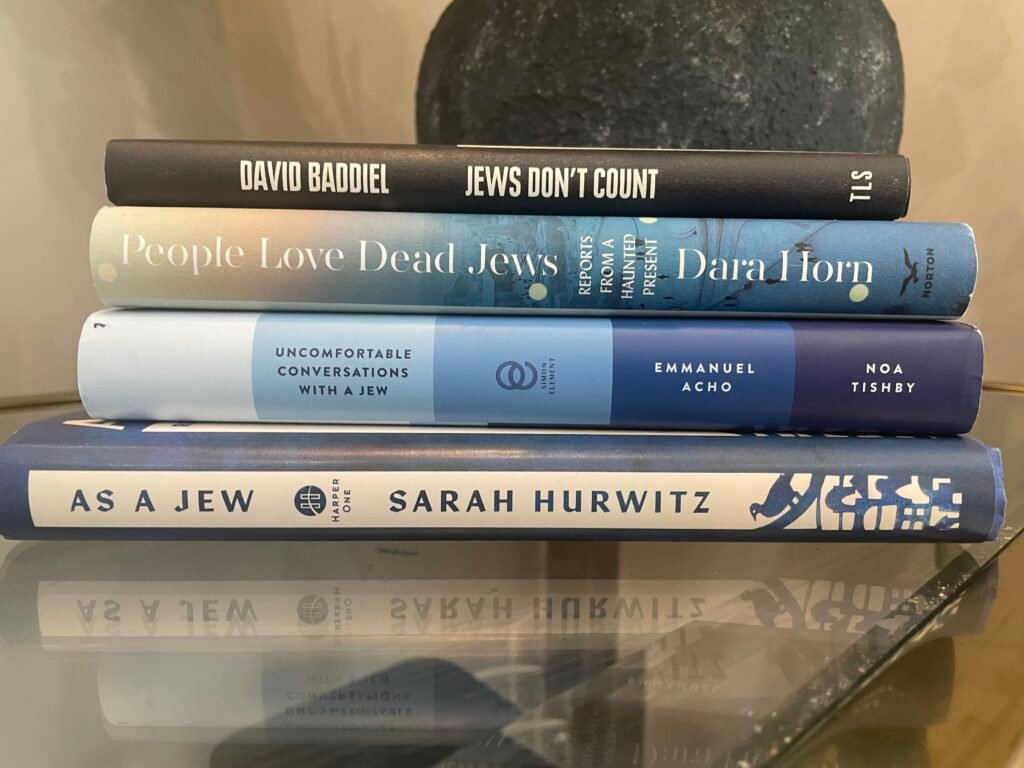
In that category I would put, “As a Jew: Reclaiming Our Story from Those Who Blame, Shame, and Try to Erase Us” by Sarah Hurwitz, “Jews Don’t Count” by David Baddiel, “People Love Dead Jews: Reports from a Haunted Present” by Dara Horn, and “Israel: A Simple Guide to Most Misunderstood Country on Earth” by Noa Tishby.
I have handed and purchased each of these books multiple times. I shared them with my wife. I gave them out to Jewish friends. I handed them to people I love, but were posting about freeing a place they had no connection with. These books should sit on every Jew’s shelf and be readied to be handed out.
While Noah Tisby has become a champion of Israel, she certainly did not start that way. “Israel” is a very digestible history of Israel. With just some basic research she easily wipes out a lot of false narratives about the land and the country itself. Having spent time over there and a connection to Israel, none of this was new, but when I handed it to others, light bulbs went on and libels were erased. “Jews Don’t Count” is written by a comedian and is a quick read, but instead of focusing on the lies told about Israel, dives into the history of how Jews have continued to be silenced. If I would boil that book down to the basic understanding it would be, “When you say, believe all women. Do you offer the same to Jewish women?”
“As a Jew” was my last book in this category, but might be the most important. Written by a former Michelle Obama speechwriter, it weaves current events, history, and her own experience into a powerful message. Talks about her own path back to Judaism and Israel. How Jews are no longer welcome in most political circles. I think the most important discussion point comes up when she talks about “Hannukah Jews.” Hellenistic Jews who were Greek first then Jewish. Jews prior to WW2 who thought they were German or French before being Jewish. And modern Jews those who value leftist Politics above actually being Jewish.” None of those other things ever saved Jews. This comes from someone who worked in the liberal ideal of politics. Carries a message of depth and weight that the larger community still needs to hear.
It was an interesting year being Jewish and looking for meaning in practice and history. A year that I am grateful for. A year that expanded and pushed well beyond showing up every Friday. And serves as a reminder of what we all must do every year, continue to grow and continue to seek a relationship with the Divine.
