Hanukkah 2025
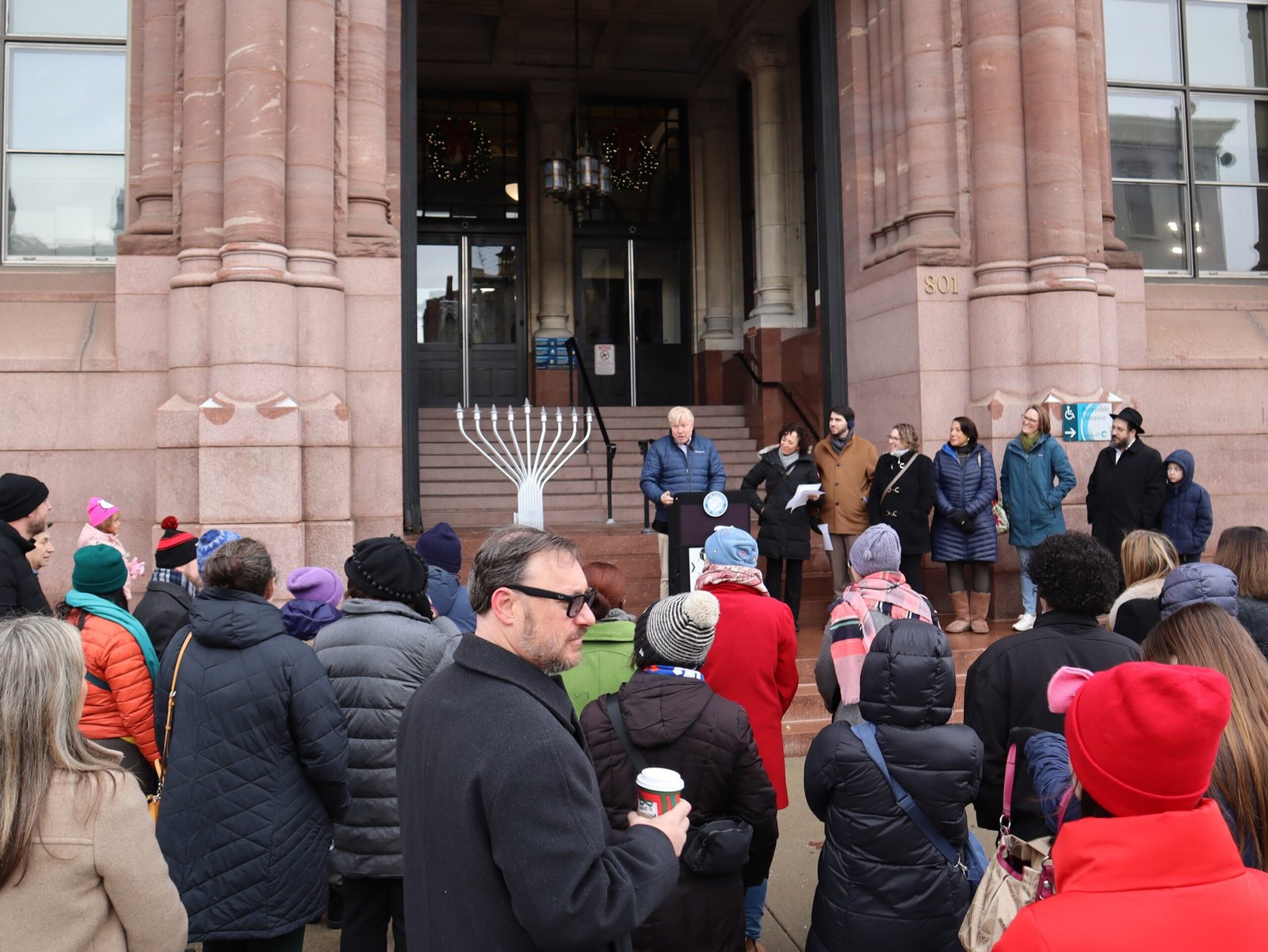
Hanukkah 2025 will not be remembered for latkes or that incredible dreidel spin. In the last 24 hours, Jews have watched a series of events unfold that are difficult to ignore: a deadly attack at a Hanukkah gathering on a beach in Australia, a shooting reported inside a Jewish Studies classroom at Brown University, and a Jewish home in California targeted while decorated for the holiday.
For many in our Cincinnati community, what happened this Hanukkah does not feel distant. The language that preceded this violence is familiar—on banners stretched across our freeways, in slogans shouted at our Jewish college students, and in speakers invited into Cincinnati who describe “Zionist institutions” as legitimate targets.
This is what contemporary anti-Zionism looks like in practice.
It is often presented as something new—a political critique, a moral stance. But Jewish leaders recognize the pattern. The vocabulary changes. The justifications evolve. What remains constant is the end result—with Jewish bodies left in public view, scenes that recall the pogroms Jews once believed were behind them.
That logic surfaced locally on the first night of Hanukkah, when CAIR Cincinnati chose to schedule its annual banquet on that night, adjacent to a synagogue. The featured speaker, Zahra Billoo, has publicly stated, “We must make Zionists afraid to walk our streets.” The remark was not disavowed by organizers. It was the draw.
Around the same time, comments were disabled on a “Happy Hanukkah” message posted by Cincinnati Public Schools after a barrage of antisemitic responses. Even a holiday greeting had become too fraught to leave open.
And so, this Hanukkah, Jewish leaders are having a difficult conversation with their communities—not about theology or tradition, but about presence.
“If there’s any holiday that calls for religious defiance in the face of violence and intimidation, it’s Hanukkah,” said Rabbi Goldschmidt of Sha’arei Torah. His congregation is still holding its events.
Others are choosing to lean into visibility rather than retreat from it.
“We’re doing it bigger than we would have before,” said Rabbi Kalmanson of the Jewish Discovery Center in Mason. He pointed to the words of the rabbi in Bondi, Australia, who was asked last year how Jews should respond to rising antisemitism. His answer was simple: be more Jewish.
For other leaders, that visibility isn’t just about size—it’s about lowering barriers and making participation feel easier, not harder.
“We talk a lot nowadays about encouraging people to ‘come as they are’ when participating in Jewish life,” said Rabbi Noah Ferro of Northern Hills Synagogue. “Wearing pajamas to a Hanukkah celebration is one way to do that. It shows a sense of humor and helps set people at ease. And for those of us bringing kids to an evening event, it’s a bonus to know some of bedtime is already done before we even leave the house.”
Still, no one is pretending this choice is easy.
“People are afraid, and we understand that,” said Dikla Karito of AD 120. “Each situation is individual, and people should learn how to protect themselves and know what to do in certain situations. That knowledge alone can increase a person’s sense of security.”
Karito, whose recent event included teaching children basic Krav Maga techniques, said her programming is moving forward regardless of turnout.
“We are celebrating life and our culture as planned,” she said. “Whether 50 people come or 200, we will be there. Jews from all walks of life are welcome.” The event ultimately drew a full crowd.
Jewish institutions are also working quietly, and deliberately, to support that decision.
SAFE Cincinnati, the Jewish Federation of Cincinnati’s community security initiative, coordinates year-round with synagogues, schools, and Jewish organizations across Greater Cincinnati, maintaining close communication with local, state, and federal law enforcement.
“We understand why some people feel hesitant right now,” said Danielle V. Minson, CEO of the Jewish Federation of Cincinnati. “Hanukkah is about choosing to be seen, and we’re committed to supporting Jewish gatherings so families can participate in ways that feel safe and right for them.”
That balance—between fear and resolve—is also being navigated on a deeply personal level.
“We are one people—what happened at Bondi is palpable across the Jewish community,” said Erica, a Cincinnati community member. “I want to be afraid, but instead I won’t be. I’ll do the best I can to defend myself, G-d forbid I should need to. That’s why I’m taking steps like learning Krav Maga.”
None of this is abstract. When Jewish leaders find themselves reassuring congregants, coordinating security, and encouraging attendance at a holiday celebration, something fundamental has shifted.
Cincinnati is a city that prides itself on being welcoming, pluralistic and safe. That is precisely why it should trouble us that Jewish families are weighing whether to attend a Hanukkah event at all—parents deciding whether to bring their children, organizers planning celebrations around fear.
Hanukkah has never been a holiday about safety. It commemorates a decision to practice Jewish life openly, even when doing so carried risk. The menorah is meant to be placed in a window.
This year, we at the Israelite are choosing to light our menorahs publicly. And that, more than anything else, is what Hanukkah 2025 will be remembered for.
