Antisemitism is back in circulation at the Cincinnati Public Library
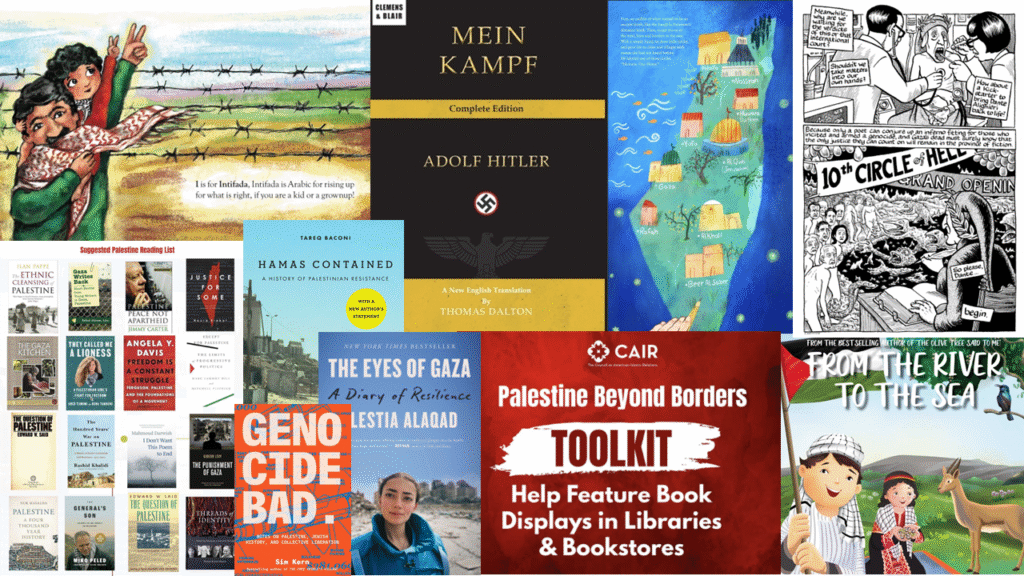
CINCINNATI – At the Cincinnati & Hamilton County Public Library, children can learn that “I is for Intifada.” Adults can borrow a comic depicting Joe Biden holding a severed Palestinian baby’s head above its bleeding body as a gift to Benjamin Netanyahu. And families can check out the latest 2026 edition of Adolf Hitler’s Mein Kampf (published by a neo-Nazi publishing house) now available at three different branches.
In the wake of the October 7 attacks and the ensuing 2023 war in Gaza, the fight over antisemitism and the Israeli-Palestinian narrative has rapidly escalated. We watched it fracture college quads, hijack city council meetings, and dominate the streets. Now, that ideological war has quietly found a new front: the Cincinnati & Hamilton County Public Library.
How does a taxpayer-funded institution become a repository for this kind of material? A review of the system’s holdings suggests it isn’t an accident, but rather the result of coordinated advocacy. Specifically, there is a striking overlap between Cincinnati’s catalog and the “Palestine Beyond Borders” toolkit – a campaign launched by the Council on American-Islamic Relations (CAIR) in December 2023 to aggressively elevate Palestinian narratives in bookstores and libraries.
Between the toolkit, the publishing dates and comments on the library catalog, it seems like there was a massive increase in Palestinian narratives in 2024 to now. Out of CAIR’s toolkit, the library bought 14 of the 16 adult suggestions. For the two adult titles not found, the system holds other Palestine-related works by their authors. The library has not responded to questions of whether their catalog on Palestine was curated in collaboration with CAIR or other Palestinian organizations.
The children’s collection offers a particularly revealing view of those decisions. The library holds five copies of a children’s book called From the River to the Sea, which presents a journey through Palestine without Israel or Jews. The catalog also lists eighteen copies of A Map for Falasteen. CAMERA, the pro-Israel media-monitoring organization, criticizes the book for romanticizing stone-throwing and portraying a future Palestine in which Israel’s Jewish inhabitants, culture and religious life have disappeared. Another title, P Is for Palestine, where “I” stands for “Intifada” – the waves of violent terrorism that rocked Israel during the 1990s and early 2000s.
Stone-throwing imagery also appeared in an event held at a Cincinnati library. In March 2025, the Cincinnati Palestine Solidarity Coalition promoted “Stones & Palestinian Resistance,” a stone-painting gathering at the Walnut Hills branch. Its flyer featured a masked figure drawing back a slingshot. Beneath that image, the event was advertised as “Family Friendly.”
In the adult collection, Joe Sacco’s War on Gaza uses graphic violence and biblical parody to indict Israeli and American leaders. One panel depicts Biden holding a severed infant’s head as blood spurts from the body below and missiles fall on Gaza. The accompanying text calls Biden’s account of seeing images of beheaded children a “hallucination” that supplied Israel with an “atrocity bonus.” Elsewhere, Benjamin Netanyahu appears on a cloud above Biden under the words “a reading from the book of genocide.” Israeli soldiers handle Palestinian women’s underwear and pose for a photograph amid gunfire. The closing imagery consigns naked figures to an imagined circle of hell, where monsters are ready to finish American and Israeli leaders. Cincinnati holds six copies. The system also holds thirteen copies of Sacco’s Palestine across two editions – where on page two, the protagonist threatens the “Jews” and to “smash Israel”.
A small survey of the library’s catalog for 2026 titles that contain Israeli, Palestinian or antizionist narratives revealed that the library obtained thirty two titles – only three books out of those titles represented positive views on Israel, eleven presented anti-Zionist arguments, and 8 presenting Palestinian narratives.
As for books on order, the only Jewish or Israeli narrative I found was Dara Horn’s The Final Solution to the Jewish Question. The library has four Palestinian and antizionist narratives – including Tareq Baconi’s What Now. The library holds Baconi’s previous works: Fire in Every Direction and Hamas Contained. In his 2024 updated author’s statement, Baconi states that October 7th “was an unprecedented and bloody display of anticolonial violence. It can be read only as a response to Israel’s relentless provocation of occupying another people, besieging them, and denying their freedom and right to self-determination for more than 75 years.” He also repeatedly refers to Israelis as Jewish settlers, and in a recent interview, the author said that they “must undo Zionism and liberate Palestine from the river to the sea.”
The library also acquired four copies of Mein Kampf this year by editor Thomas Dalton and published by a neo-nazi publishing house Clemens & Blair. In promoting the books, Clemens & Blair stated “all British or American publishers were inherently biased against the author and his ideas. They had no real interest in producing a clear and accurate translation; in fact, just the opposite—they were anxious to portray the ideas as jumbled, incoherent, and even insane. The reality is very different than this. Hitler offers a clear and coherent account of history and his own worldview. His ideas resonate to the present day.”
Clemens & Blair also publishes The Protocols of the Elders of Zion, the Aryan Bible and Did Six Million Die? In 2020, the Jewish Chronicle reported that Amazon had removed two Dalton books, The Jewish Hand in the World Wars and Eternal Strangers. Their promotional descriptions blamed Jews for fomenting wars and suggested that persistent hostility toward them originated in Jews themselves.
Library officials say they are working on answers, though they have declined to say when they will provide them. But for many in Jewish Cincinnati, the real question isn’t when the library will respond; it’s how these titles bypassed the system’s own Collection Development Policy, which mandates that content be evaluated for “accuracy of information, comprehensiveness, integrity, and purpose.” The library may invoke intellectual freedom to defend its catalog, but its own rules demand a balanced collection. Looking at the stacks today, that balance is impossible to find.
Editor’s note: Shortly after publication, the library spokesperson answered questions submitted to the library a week ago. They consistently pointed to the library’s Collection Development Policy, and stated “staff use professional judgment and consider anticipated demand, community interest, the existing collection, systemwide availability, physical space, acquisitions procedures, and available budgets when choosing titles, quantities, and locations. As a result, the number and placement of copies may vary by title. Copy counts are not intended to provide equal numerical representation of particular viewpoints.” The library denied any working relationship with CAIR or other organizations when developing its catalog.
