Who Dey or Oy Vey?
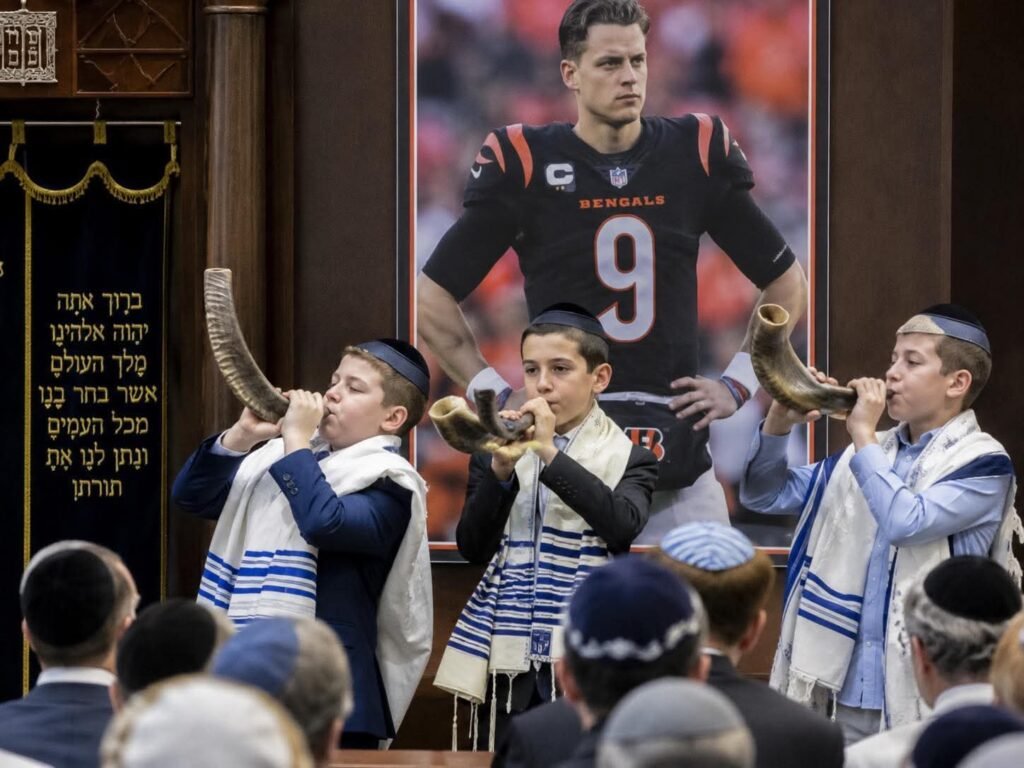
CINCINNATI – If you are a Jewish Bengals fan, Sept. 13 may already be circled twice on your calendar: once for the Bengals will open their season against the Tampa Bay Buccaneers at Paycor Stadium; twice for the second day of Rosh Hashanah. In other words, Cincinnati Jews are being forced to choose between Who Dey and Tekiah. Or will they?
There is remarkably little rabbinic guidance specific to what a Cincinnati Jew should do when the Bengals’ opener falls on a High Holiday. The Talmud addresses lost property, rampaging oxen and damages caused by an unattended pit. It says nothing about the despair after watching Burrow’s offensive line.
After speaking with the rabbis, I discovered that the situation is even more complicated than it appears: Not every Jewish family observes Rosh Hashanah in the same way. Many American Jews celebrate only the first day and see no conflict at all. Others plan to attend services Sunday morning and catch the game afterward. However, there is a third group that plans to go to shul and will refrain from watching television until the holiday ends that evening.
It turns out that the second day of Rosh Hashanah may be even more important than its predecessor because the first day of Rosh Hashanah falls on Shabbat. The shofar is not sounded on Shabbat, so worshippers wait until the second day to hear it. That led me to an obvious question: Could a shofar blown at Paycor Stadium fulfill the mitzvah?
Rabbi Samantha Schapera of Northern Hills Synagogue gave the Israelite her official rabbinic ruling, “One could say that anywhere you hear the shofar, you are fulfilling the mitzvah.”
But for those attending services that day, different questions arise: Is it appropriate to pray for a winning season? Can Joe Burrow be added to the Mi Shebeirach list preventively? Does an orange-and-black kippah qualify as High Holiday attire? And can the rabbi provide score updates from the bimah?
No official rabbinic ruling has been given on the preventive Mi Shebeirachs, but it can’t hurt. As for the orange and black Kippas, Rabbi Schapera said she’s seen a few in the past, but on the question of updates on the bimah, she had some concerns, ““Rosh Hashanah is a time for focusing on spirituality, and focusing on football will take away from the sanctity of the moment.”
Offering rabbinical guidance for Joe Burrow’s beleaguered offensive line, Rabbi Gary Zola turned to the Babylonian Talmud (Shabbat 32a) to address the quarterback’s constant exposure in the pocket. “Oh, that is easy!” Zola remarked. “A person should never, never remain in a place of danger.”
However no question looms larger for Cincinnati’s Jewish Bengals fans than this: Does Rosh Hashanah require them to forgive the Pittsburgh Steelers?
Mention the Steelers and Cincinnati’s Jewish community can produce its own Al Chet: Keith Gary twisting Ken Anderson to the turf by his facemask in 1983; Kimo von Oelhoffen’s low hit ending Carson Palmer’s 2005 season; Hines Ward’s block breaking Keith Rivers’ jaw in 2008; and Terence Garvin’s unpenalized hit breaking Kevin Huber’s jaw and fracturing a vertebra in 2013. And that is all before reaching the 2015 wild-card game, for which no amount of chest-beating has yet produced forgiveness.
Schapera compared the rivalry to the disagreements between the schools of Hillel and Shammai. Their arguments were considered machloket l’shem shamayim (disagreements for the sake of Heaven) and compared the conflict to their followers continuing to marry one another despite their differences.
“Healthy opposition is good for the game,” Schapera said. “But when you start to hate people, it is no longer a disagreement for the sake of Heaven.”
Rosh Hashanah gives fans an opportunity to admit when they have crossed that line, forgive one another and resolve to do better. Presumably Pittsburgh must also demonstrate genuine repentance, and Judaism does not require Bengal’s fans to be naïve.
But we still have not answered the most important question: Is there a loophole for a halachically observant Jew to watch the Bengals’ opener? It turns out there is: spend Rosh Hashanah in Israel, where the holiday ends before the 8 p.m. kickoff. Fans can hear the shofar, complete the holiday and still watch the game live. That the most convenient halachic workaround requires a trip to the Jewish state does not prove the Bengals are Zionists, but it does beg the question.
