Faith, Family, and the Weight of Responsibility: A Review of “Where We Keep the Light: Stories from a Life of Service”

It is a long-standing tradition for public figures to release memoirs as a way to reflect on their experiences and share the values that have shaped their lives. Where We Keep the Light: Stories from a Life of Service fits squarely within that tradition, offering readers a personal account of Josh Shapiro’s upbringing, faith, and professional journey.
Shapiro is Jewish, raised by Conservative parents, and educated in Jewish day schools—a tradition his children continue today. Faith is an active and grounding presence in his life: he prays regularly and observes Shabbat every Friday night. Throughout the book, Shapiro presents faith not as something insular, but as a source of openness and connection. By allowing his own light to shine, he creates space for others to do the same.
This isn’t a novel, and it doesn’t try to be. It’s a personal story, told with intention, meant to show who Josh Shapiro is, what he believes, and how those beliefs show up in his life and work. – Ryan Mount
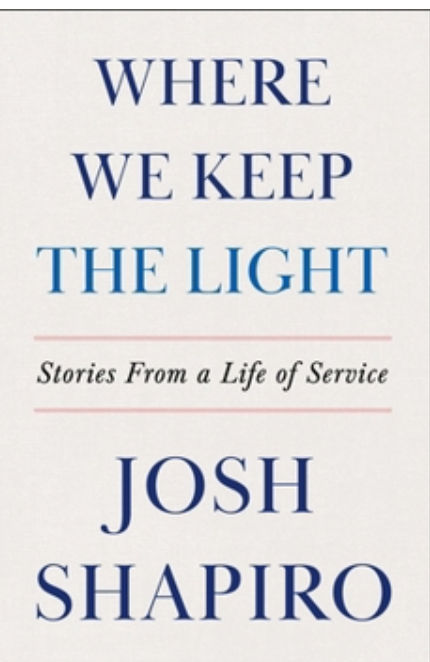
One of the book’s most compelling early chapters focuses on relationships that extend beyond Shapiro’s own community. He writes movingly about his friendship with Rev. Marshall Mitchell, senior pastor of Salem Baptist Church in Abington, Pennsylvania. This chapter highlights the sincerity of Shapiro’s faith and illustrates how shared values—rather than shared backgrounds—can form the basis for deep and lasting connections.
A recurring theme throughout the memoir is independence of thought and moral clarity. Shapiro describes moments in his career when he chose principle over convenience, even when those choices were uncomfortable. These stories emphasize a willingness to question assumptions, confront wrongdoing, and act in accordance with his conscience.
The book also highlights Shapiro’s emphasis on accountability and fairness. He reflects on his role in addressing a far-reaching child abuse scandal within the Catholic Church, describing the seriousness with which he approached cases involving vulnerable people. These experiences fit into a broader pattern he describes throughout the memoir—working within complex systems, addressing misconduct when it arises, and paying close attention to those who might otherwise be overlooked. He also shares examples of efforts to address unfair labor practices and encourage greater responsibility from large institutions and corporations.
Shapiro’s story is also shaped by his encounters with antisemitism, a presence that follows him even as he moves through public life. In 2018, he was serving as Pennsylvania’s Attorney General when the Tree of Life synagogue massacre took place. As the state’s chief prosecutor, he was confronted not only with the legal gravity of the moment, but also with the deeply personal challenge of explaining such senseless violence to his own children.
Years later, during Passover, Shapiro and his family were targeted while staying at the Governor’s Residence. In reflecting on that moment, he emphasizes that the attack was not just against his household, but part of a broader fear shared by Jewish families across the country in the wake of October 7. He continued to advocate with quiet determination for Jewish students and their communities, urging that their voices be heard and their safety cherished amid a growing tide of antisemitism.
He also recounts a troubling moment during a vetting process, when he was asked whether he had ever acted as a secret informant for the Israeli government—a question he experienced as rooted in an old and painful stereotype. This contrasts with the fact that Catholic leaders such as John F. Kennedy or Joe Biden were never asked to account for their loyalty to the Vatican, underscoring the double standard Jewish public figures continue to face.
Despite the challenges he faces, he never wavers in his devotion, wearing his faith openly and letting it illuminate every part of his life.
This isn’t a novel, and it doesn’t try to be. It’s a personal story, told with intention, meant to show who Josh Shapiro is, what he believes, and how those beliefs show up in his life and work. And in that sense, it does exactly what it sets out to do. By the end, readers walk away with a clear feel for his character, his motivations, and the responsibility he takes seriously.
For anyone interested in stories of faith, service, and ethical leadership, Where We Keep the Light is a thoughtful and engaging read—and one that is well worth the time and consideration of a broad audience.
Author’s Note: The opinions expressed herein are those of the author and do not represent the editorial position of The American Israelite.
